
Wheat Ridge moves forward on Lutheran Legacy Campus redevelopment; council gives consensus to pursue land exchange with developer
Get AI-powered insights, summaries, and transcripts
Subscribe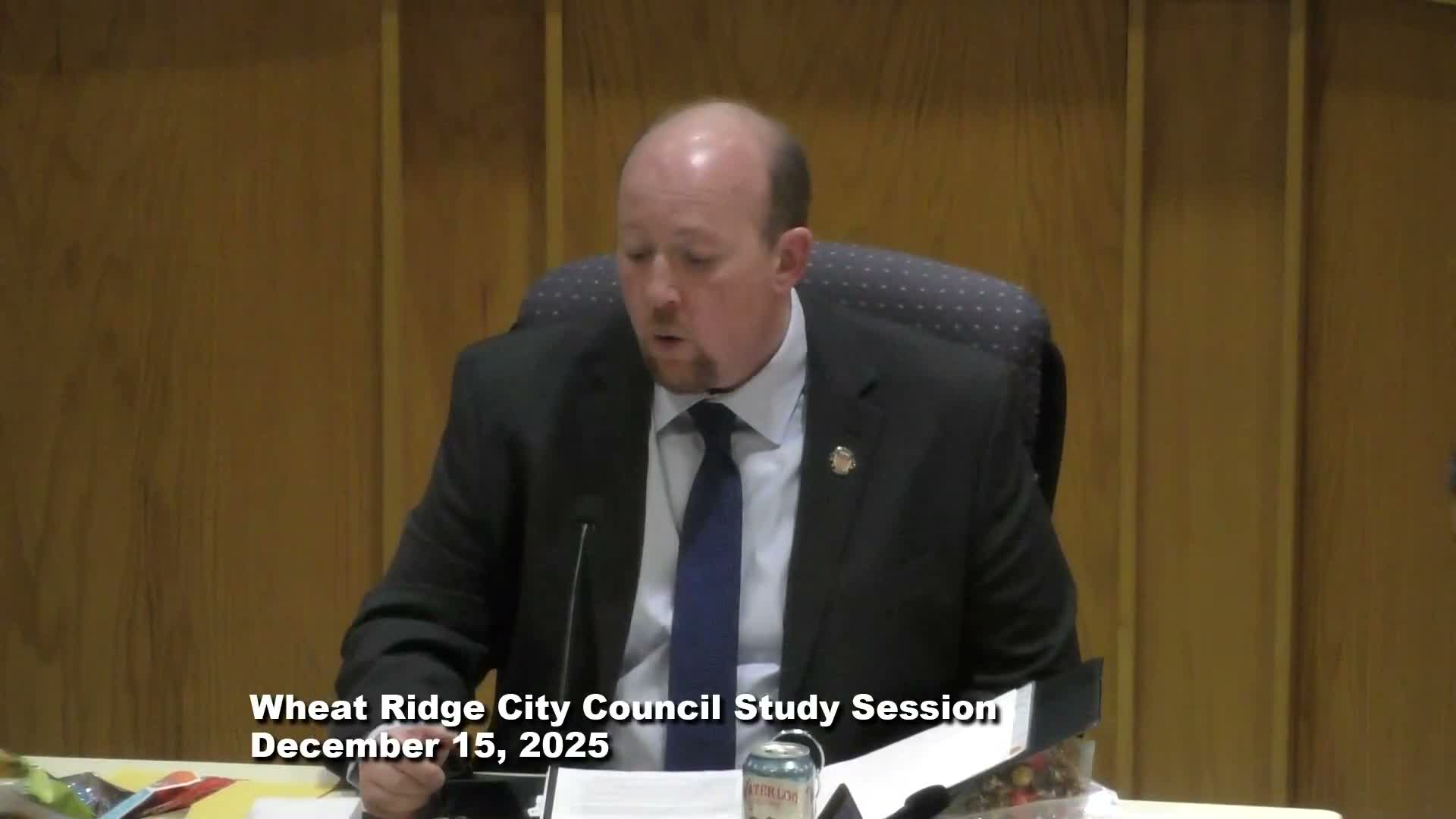
Summary
At a Dec. 15 study session the Wheat Ridge City Council heard staff and developer e5x outline the Lutheran Legacy Campus master plan, financing tools and timeline, and gave consensus to continue negotiating a land-exchange agreement and financing strategy for a potential civic center on the site.
Wheat Ridge City officials on Dec. 15 updated the council on years of planning for the Lutheran Legacy Campus and signaled support to continue negotiating a land-exchange with developer e5x that could site a new municipal civic center on the former hospital campus.
City planning staff recapped the site’s history: SCL Health purchased about 26–27 acres at Clear Creek Crossing in 2018, later merging with Intermountain Health, and opened a new hospital in August 2024. A community-driven Lutheran Legacy Campus Master Plan adopted in October 2021 shaped zoning and ballot changes that followed. Staff said the city translated the plan into a detailed zoning ordinance (about 50 pages) and a 2024 charter amendment capping building heights at five stories in the center and 2.5 stories along the perimeter, a measure that passed with roughly 67% voter approval.
Patrick and Lauren, city staff leading the project, told the council that after a competitive selection process e5x closed on the campus last week and will be the new owner. City action earlier in 2025 established a Legacy Metropolitan District (service plan approved in January 2025) that staff said allows up to $110,000,000 in debt and a 67-mill maximum, and an Urban Renewal Plan approved in September 2025 to use tax-increment financing to address blight and fund public infrastructure. The Wheat Ridge Urban Renewal Authority also approved a finance agreement pledging increment to the metro district for the lesser of $75,000,000 or 25 years.
Developer Chris Elliott of e5x described the land-use intent: lower-density single-family and duplex housing to match adjacent neighborhoods at the site edges, with higher-density multifamily and taller structures toward the center; preservation of the chapel and the so-called Blue House; retention of the Rocky Mountain Ditch and tree-lined parkways; and inclusion of pocket parks, a civic plaza that could host a winter ice rink and neighborhood-oriented retail (staff said a minimum of 10,000 square feet of retail is required).
Elliott said demolition would begin with peripheral buildings and then move to the hospital, and "I would expect that within the next 3, 4, 5 months you'll see that work commencing." He added the developer has completed testing and will follow Colorado Department of Public Health requirements for asbestos removal and related remediation before structural demolition.
Council members pressed staff and the developer on design details and community impacts. Councilor Okada asked whether the Rocky Mountain Ditch would be enclosed; staff said ditch companies typically request enclosure to protect water quality and reduce maintenance, and that enclosure with openings at either end was the most likely outcome. Multiple council members urged designers to avoid a tall perimeter wall that could create a barrier between the new campus and existing neighborhoods and asked for strong pedestrian connections to 38th Avenue/Main Street.
On civic uses, staff said the city’s 2023 facilities master plan identified aging municipal buildings and that the city hired architect Anderson House to explore options for a civic center on the campus. The library district remains in discussions but has not clarified space needs or timing; staff said timing and financing models differ between the city and the library and the library cited bandwidth and other projects as constraints.
Staff asked the council for consensus to continue negotiating the land-exchange agreement concept so the city can pursue final design, financing options and formal agreement language. Staff described a 180-day due-diligence window (with additional time if a Phase 2 environmental study is required) and reverter rights that would allow either party to unwind the exchange if conditions are not met. The council indicated consensus to move forward; staff said more detailed agreements and cost estimates will return to council for formal approval.
Next steps identified by staff include finalizing land-exchange terms, hiring architects for next-level design, continuing development-review processes (subdivision plats, site plans and permits), and refining the project’s financing strategy — which staff said could include use tax and other revenues and might require voter approval for bond authority or tax measures.
The project remains multi-year and phased. Staff and e5x estimated visible demolition and initial construction activity could begin within months, but full buildout will likely take several years and will depend on market conditions, permitting and financing.
The council’s consensus does not constitute a formal approval of any land transfer or bond issuance; staff said those items will come back to the council as discrete decisions once terms and financing are clearer.