Get Full Government Meeting Transcripts, Videos, & Alerts Forever!
Get email alerts on the Law Library And Statute Changes topic
No spam. Unsubscribe anytime.
Polk County to amend law‑library ordinance and ratify interlocal agreement as state law shifts court funding; county braces for new school‑board appointment law
Summary
Polk County leaders proposed removing term limits from the county’s 1978 law‑library ordinance to enable an active board to authorize transfers supporting courthouse security, and discussed ratifying an interlocal agreement to preserve funding after state Act 371. Officials also previewed applying Act 726, which directs counties to fill certain school‑board vacancies, and debated logistics and perception concerns ahead of a Thursday appointment.
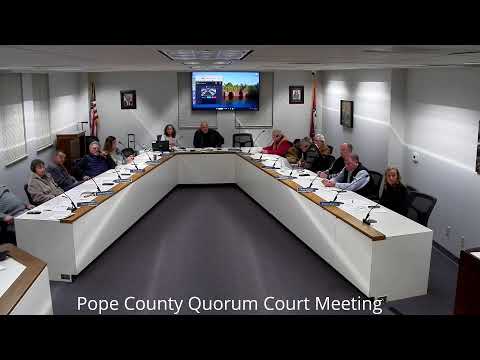
Polk County officials told the budget committee they will move to modernize the county’s 1978 law‑library ordinance, appoint library board members and enable the law library to transfer funds to support courthouse security.
Ben Cross explained the proposed ordinance change would remove term limits so the library board can maintain continuity. He said the law library has committed $50,000 a year for five years — "a quarter‑million dollars" — to help pay for courthouse security work that begins in January. Cross described a three‑step process: amend the ordinance, appoint members to bring the board current, and then allow the law library to authorize transfers to the treasurer.
Cross also briefed the court on recent state action (referred to in the meeting as 'Act 371') that made state district court judges fully state‑funded but struck language that had previously dictated how funds for public defenders, law‑library support and administrative offices should be returned to counties and cities. Polk County staff and local mayors negotiated an interlocal agreement to preserve the county’s prior funding shares; Cross said the court will ratify that agreement by resolution to ensure funding continuity starting Jan. 1, 2026.
Finally, Cross discussed Act 726, a recently effective statute that says, when a school board cannot agree on an appointment to fill a vacancy, the county quorum court 'shall' appoint a replacement. Cross said Polk County is likely the first in the state to confront the law and previewed a process for Thursday’s meeting: each applicant will present for five minutes followed by five minutes of questions. Committee members expressed concern that appointing one of two applicants who are also candidates in an upcoming primary could be perceived as an endorsement, and they discussed whether tabling the appointment until after the election or conducting more vetting would be appropriate.
No final ordinance amendment or appointment occurred in the budget committee meeting; Cross said the items will appear on the full quorum court agenda for formal action. The committee noted the statute requires open‑session consideration and that appointees and procedures must comply with the new law’s public‑meeting requirements.