
Sumner County panel urges baseline data, coordination to address volunteer fire department gaps
Get AI-powered insights, summaries, and transcripts
Subscribe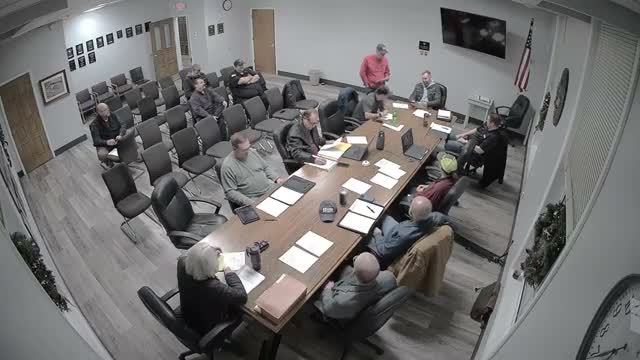
Summary
An ad hoc Sumner County committee reviewed a CTAS study, public testimony and department budgets, concluding the next step is standardized baseline data on staffing, apparatus age and funding to guide incremental improvements rather than rely on competitive grants alone.
A Sumner County ad hoc committee met to study the condition of the county’s volunteer fire departments and concluded that compiling consistent baseline data on personnel, apparatus and finances must precede major structural changes.
Committee members said the CTAS (County Technical Assistance Service) study provided useful direction but relies on data as old as 2018–2021, and requested clearer, department-level information on station ownership, number and age of apparatus, SCBA inventories and operating budgets. ‘‘We need to know how many people, stations, [and] apparatus, age things like that,’’ an attendee said when listing the data the committee asked chiefs to supply.
Public commenter Joel LaBoclan, who described years of FEMA Assistance to Firefighter grant work for Cotton Town, warned that grants are competitive and slow: "That grant is the most competitive grant program administered by FEMA," he said, explaining awards often come after multiple years on an ‘‘award list’’ and that mutual-aid narratives improved his departments’ success. Committee members agreed grants help but are not a reliable sole solution for capital needs.
Members discussed operational limits of departmental budgets — which may break down early in the year when equipment fails — and funding disparities among departments, noting at least one department receives additional cross-county contract revenue that enables it to carry debt for capital purchases while Sumner County volunteer departments generally cannot. The group also raised the procurement timeline for replacements: speakers estimated two years or longer to obtain a new engine, with price estimates for a commercial engine in the $500,000–$700,000 range.
Dispatching and coordination emerged as a central concern. One committee member cited anecdotal evidence that a single dispatcher handles fire dispatch for the county, which can produce timing and recording inaccuracies that affect response-time metrics and ISO/PPC ratings. Several speakers said improved coordination across fire, EMS and Emergency Management would be less costly than immediate, large-scale capital purchases and would help the county present coherent plans to the commission.
The committee set a short-term work plan: chiefs will be asked to provide standardized spreadsheets summarizing personnel counts, certifications and apparatus inventories; the group will focus next month on staffing and recruitment options, including hybrid paid/volunteer models and pay-per-call pilots. The meeting closed with members agreeing to continue work and to ask CTAS or a CTAS representative to return if the committee wants updates or clarification of state requirements.
The committee did not adopt any binding countywide structure at the session and recorded no formal roll-call votes on structural changes. It next plans to meet to examine staffing baselines and recruitment strategies.