
San Leandro council backs staff to advance rent registry and stabilization with funding guidance
Get AI-powered insights, summaries, and transcripts
Subscribe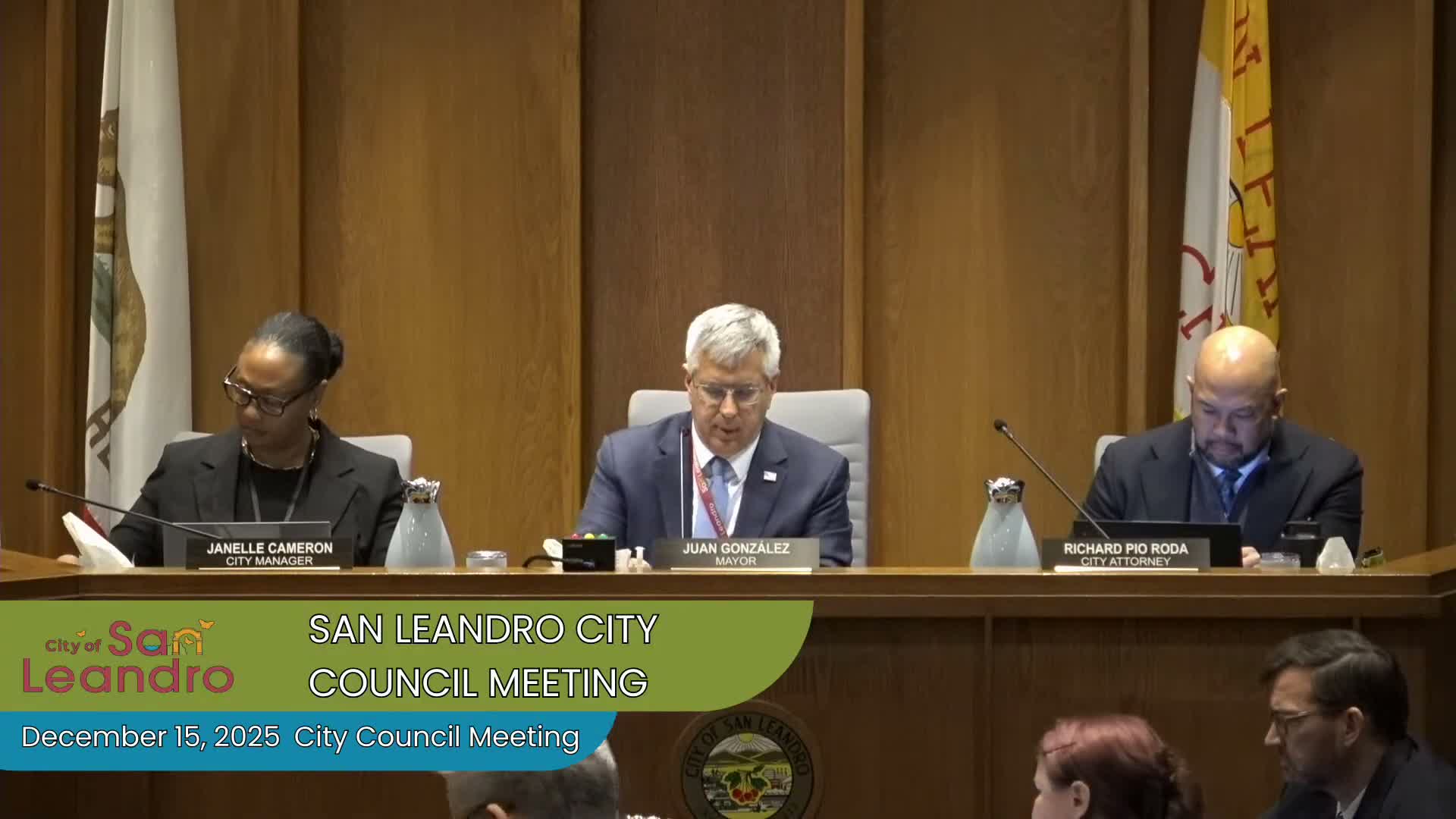
Summary
Council directed staff to move forward with an enhanced rent-registry plus rent-stabilization program, advising a cap of 3% or 65% of CPI (whichever is lower), a 2025 base‑rent date, and a full cost‑recovery model that could use a one‑time general‑fund loan of roughly $1.3M–$2.2M and six additional FTEs.
San Leandro’s City Council on Monday gave staff majority guidance to pursue an ‘enhanced enforcement’ rent program that bundles a rent registry and a rent stabilization ordinance and to return with refined fees and a loan document after a fee study.
Community Development Director Tom Liao told the council the combined program would likely cover about 7,000 fully regulated units and, when partially regulated (Costa Hawkins) units are included, a range of about 9,000–10,000 rental units. Liao presented a one‑time general‑fund loan model to launch the program and estimated an initial loan between about $1.3 million on the optimistic side up to $2.2 million, repayable over three to six years depending on fee levels and enforcement actions. He also described staffing at the enhanced level as six total full‑time equivalents (including two positions already allocated for the registry).
On program fees and enforcement, staff modeled a per‑unit fee range that, in staff materials, appeared as approximately $2.50–$300 per year for fully regulated units and $125–$175 per year for partially regulated units, with an emphasis that stronger enforcement and penalties would speed loan repayment. Liao said the staff recommendation is to pursue a full cost‑recovery framework and to establish a special revenue fund so program fees and costs are tracked separately.
Public commenters included tenants and tenant advocates who urged stronger protections and an earlier base year to reduce incentive for landlords to spike rents. Richard Becker, a long‑time renter, told the council, “I urge you to approve the rent stabilization ordinance because it is good public policy.” Several landlord‑representing groups and individual housing providers urged caution, citing rising insurance and utility costs and the operational costs of running rental properties.
Council discussion produced a majority direction on several items: limit annual rent increases to 3% or 65% of CPI (whichever is lower), set base rents at a 2025 level (several members proposed a 2025 base year), and move forward with the enhanced enforcement, full cost‑recovery model that includes the 6‑FTE staffing assumption. Mayor Gonzales closed the item saying the council had reached majority guidance.
Staff outlined next steps: a final fee study and refined budget are expected in February–March, staff will return with a loan appropriation/repayment plan if the general‑fund loan option is pursued, the city aims to bring the registry software contract to council in late January, and staff proposed bringing a first reading of the stabilization ordinance on Jan. 12 with a second reading in early February. Liao said the proposed effective date in staff materials for the rent stabilization measure is Jan. 1, 2027, with the base year to be set in 2026.