
Cleveland City Schools highlights network upgrades and classroom AI in technology update
Get AI-powered insights, summaries, and transcripts
Sign Up Free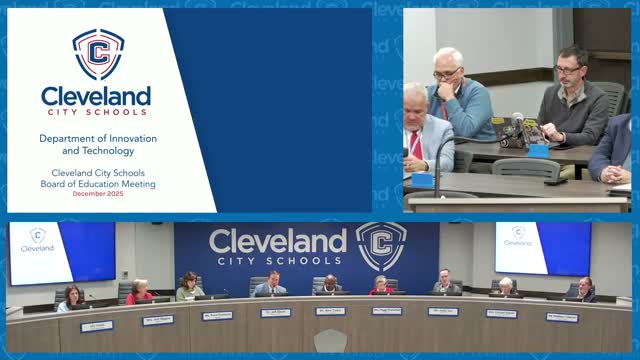
Summary
District technology leaders described a migration to a new ISP and security operations that they say improve reliability and save the district an estimated $65,000 per year, and outlined classroom uses of an AI tool called 'Magic School' and Magma Math.
Cleveland City Schools presented a technology-focused strategic-plan update describing both infrastructure upgrades and instructional uses of artificial intelligence.
Doctor Raper, the district’s technology director, told the board the district migrated to UDT as its Internet service provider and has doubled site egress capacity to 10 gigabits per second, with internal 10 gigabit fiber backbone. "It's been a very successful migration," he said, noting failover handled an instance of a fiber cut without user impact. He described new out-of-band management and MXDR (managed detection and response) security monitoring to provide 24/7 threat detection; the district estimates the change will save about $65,000 annually, with roughly $58,000 covered by E-rate funding.
On classroom tools, Raper described a district purchase and rollout of an AI learning environment called Magic School that teachers can enable for students. "Magic School...is only available to the students if the teachers allow it. The teacher can see all the chats that are happening. They can monitor it," he said, explaining teacher controls and guardrails. He also highlighted Magma Math, an instructional tool that allows students to write math on iPads, capture work and provide hints and instant feedback to teachers.
Raper said device refresh planning remains on a three-year cycle: the district rolled out about 2,750 elementary iPads this summer; planned purchases include roughly 1,375 middle-school iPads and about 500 MacBooks for teachers during the next cycle, followed by 1,775 high-school iPads the year after that.
The board asked about device disposition and resale; Raper said the district solicits buyback quotes from vendors and uses proceeds toward replacement devices. No policy changes were proposed during the meeting.
Next steps: District staff will continue procurement and budgeting work for upcoming refresh cycles and maintain oversight of UDT/ISP and MXDR arrangements.