Get Full Government Meeting Transcripts, Videos, & Alerts Forever!
Get email alerts on the Parks And Recreation topic
No spam. Unsubscribe anytime.
Warren County unveils 5–7 year parks and recreation strategic plan, officials cite major capital needs
Summary
Warren County Parks & Recreation presented a five- to seven‑year strategic plan Dec. 4 that outlines deferred maintenance across 41 facilities, recommends large capital investments and asks fiscal court to consider boosting operating funding and potential tax support to remain a regional leader.
Warren County officials on Dec. 4 heard a detailed strategic plan from the county’s Parks & Recreation leadership calling for a multi‑year investment to repair aging facilities, expand indoor capacity and preserve the county’s role as a regional host for tournaments.
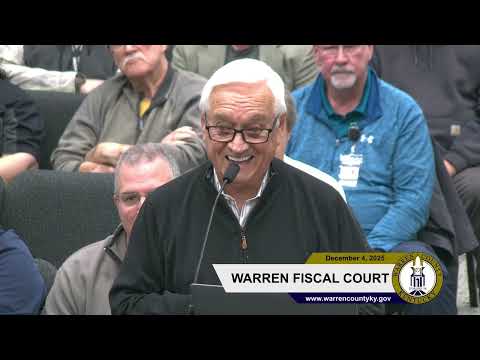
Chris (Warren County Parks & Recreation) told the fiscal court the department operates 41 facilities on roughly a $6.7 million annual budget, with about $3.5 million devoted to operations and wages. He said deferred maintenance has left ‘‘38 ball fields in some state of needing major repair’’ and flagged shortages of indoor space, parking and modern restrooms that are reducing tournament business. The presentation was based on a community survey of 1,152 respondents and the BG 2050 regional study.
‘‘We’re in a crisis of making some strategic decisions on what direction we’re gonna move,’’ Chris said, summarizing the findings and the department’s proposed objectives. He listed participation and program growth metrics for 2024–25, including 6,779 crew hours, 1,652 tires collected, 16,985 miles driven and 23,637 bags of litter removed by county crews and inmate work crews.
Bart Darrell, speaking as an advisory council member, urged the court to treat the proposals as investments rather than expenses and estimated a seven‑year capital program of about $49 million to bring facilities to regional standards. ‘‘This is not fluff. This is not a wish list. This is right now where we are in trouble,’’ Bart said, urging the county to raise operating support toward regional peer averages.
Survey results presented by staff showed broad resident support for parks spending: 60% of survey respondents favored a small tax increase to support parks and recreation, while 43% opposed higher user fees. The plan groups 82 strategic objectives across facility improvements, program expansion, workforce development, sustainability, capital projects and deferred maintenance planning, with quarterly internal reviews proposed.
Chris and the advisory council recommended targeted actions including: renovating ball fields (noting typical annual national maintenance of $15,000–$20,000 per field), pursuing artificial turf and infield tarps to reduce rainouts for tournament play, increasing indoor aquatic capacity aligned with a city feasibility study, securing two larger parcels (recommended 120–140 acres) for future regional facilities, and creating smaller 5–15 acre community parks in high growth neighborhoods.
The presentation compared Warren County’s per‑capita spending to regional peers and national benchmarks, showing the county below median investment levels for similarly sized communities. Staff said the department had performed a statistically valid public survey and more than 7000 internal responses across outreach activities and civic engagement.
Fiscal court thanked the presenters and indicated staff would review the packet of recommendations; no binding funding decision was taken at the meeting. The next steps listed in the presentation include quarterly progress reviews, further feasibility work for specific capital projects and discussions with the fiscal court on funding options and potential bonding.