Get Full Government Meeting Transcripts, Videos, & Alerts Forever!
Get email alerts on the Open Government topic
No spam. Unsubscribe anytime.
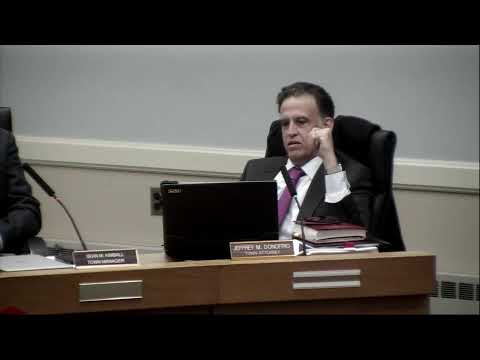
Town attorney briefs Cheshire council on FOIA, executive sessions, public records and ethics
Summary
Town Attorney Jeff D'Onofrio gave an orientation Dec. 1 on the Freedom of Information Act, categories of public and non-meetings, executive session rules and permissible topics, public-records handling and the town ethics ordinance; he emphasized notice, redaction, and the 4-business-day denial rule.
Jeff D'Onofrio, the town attorney, presented an extended orientation to the newly seated and returning council members explaining how the Freedom of Information Act (FOIA) and related Connecticut practice affect council business.
D'Onofrio summarized FOIA's three core concepts: it applies to public agencies, public meetings and public records. He stressed that "FOIA applies to meetings of public agencies" and that a council member has no individual authority outside properly noticed public meetings: "The only power you have is derived from a meeting at which a quorum of the council takes action," he said.
He described categories of gatherings that are not treated as public meetings under FOIA (for example caucuses limited to members of a single political party, chance or social gatherings and certain interviews), and he cautioned that electronic communications among members can create FOIA problems when they amount to deliberation outside public view. He reiterated that executive sessions are permitted only for limited, enumerated reasons and must be on the agenda with a clear stated purpose when convened.
On public records and requests, D'Onofrio walked members through the practical rules the town uses: acknowledge requests promptly, forward complex or potentially exempt requests to counsel, and be mindful of exemptions. He explained the commonly cited four-business-day period for issuing a denial and described his practice of interpreting "promptly" for production as generally within 30 days in routine cases, while noting exceptions for very broad or complex searches.
D'Onofrio reviewed charter provisions cited in the orientation governing the council's legislative and fiscal responsibilities, how ordinances and public hearings operate, the council's role as fiscal authority and rules for borrowing and capital budgets. He also reviewed the town ethics ordinance, urging disclosure and recusal where conflicts or appearances of impropriety exist.
The presentation concluded with practical advice on record redaction, handling attachments, and the requirement that executive sessions list the purpose and any non-agency attendees. Council members were invited to ask follow-up questions offline.
D'Onofrio closed by offering to assist with individual questions and legal interpretations outside the meeting.