
West Palm Beach Historic Preservation Board approves several projects, denies Ardmore garage-apartment and continues multiple cases
Get AI-powered insights, summaries, and transcripts
Subscribe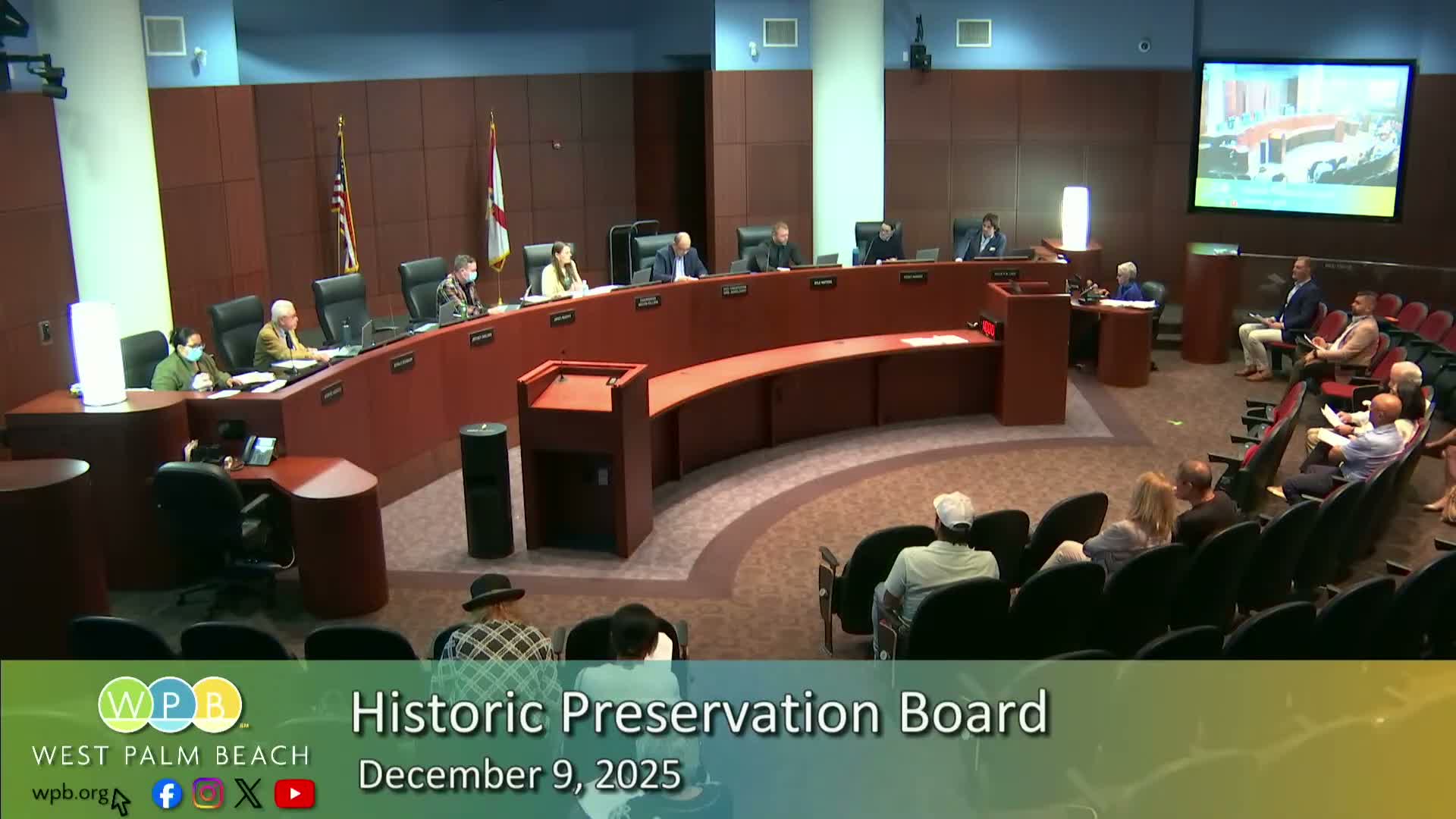
Summary
At its Dec. 9 meeting the West Palm Beach Historic Preservation Board approved several certificates of appropriateness, denied an application to add a garage-apartment and pool cabana at 734 Ardmore Road, and continued several contentious or technically incomplete cases for redesign or more documentation.
The City of West Palm Beach Historic Preservation Board met Dec. 9 to review a packed agenda of additions, new construction and variances across multiple locally designated historic districts. After a series of staff presentations and public comments, the board approved three consent items and several full applications, denied one application and continued multiple cases for additional work or clarification.
Board business opened with routine roll call and a staff announcement that the applicant for 110 West Westminster Road had requested a deferral to Jan. 27. Jordan Hodges, the city’s historic preservation planner, and Anthony Mendez, case manager, delivered a broad staff update: the historic preservation program completed 10 ad valorem tax-exemption work applications in 2025 (eight of those resolutions were approved at the city commission the previous day) and staff processed some 782 applications across permitting and certificates last year. Hodges also noted rising costs on historic plaques and upcoming improvements to the city’s electronic plan submittal and record packages.
Votes and formal actions at a glance: the board approved minutes from Oct. 28 and carried the consent agenda (cases 25-91: 3025 Beeson Rd; 25-93: 205 Glenmont Dr; 25-82: 322 Marlborough Pl). The board continued HPB 25-61 (229 Plymouth Rd) and HPB 25-79 (3180 Washington Rd) to January for design revisions and additional materials; it denied HPB 25-80 (734 Ardmore Rd) after neighbors and several board members voiced concerns about scale, privacy and cumulative site fill; it approved HPB 25-83 (707 Canooga Dr) and HPB 25-84 (275 Flamingo Dr) with conditions; and it continued HPB 25-85 (349 Plymouth Rd) and the variance-linked HPB 25-87B (365 Plymouth Rd) for further study and clearer demolition/driveway/garage options.
The board repeatedly grounded deliberations in the Secretary of the Interior’s Standards and the city’s zoning code. Staff and board members emphasized three design principles for new work in historic contexts: compatibility (materials and rhythm), subordination (new massing should not overwhelm contributing buildings), and differentiation (new construction should not create a false sense of historic development). Where staff found projects could meet standards through conditions, they recommended approval; where compatibility concerns or missing technical information were substantial, staff asked for continuances or recommended denial.
A single contested denial: 734 Ardmore Road. David Lawrence, architect for the applicant, proposed a second‑story garage apartment and a 300‑square‑foot cabana. Neighbors submitted letters and spoke at the meeting, citing heavy site fill already placed, loss of privacy, and that a second story had been denied in a prior iteration. One neighbor said construction activity had left her yard four feet higher and claimed $5,000 in damaged plantings; the applicant responded that FPL required the tree removals and offered to increase screening. Staff had suggested conditions for the cabana and accessory structure, but the board concluded the proposal did not meet the standards and voted to deny the application.
Continuances and technical follow-up. Several applications were continued to give applicants time to resolve specific items: 229 Plymouth (second-story addition) needs clarified roof massing and fenestration revisions per staff conditions; 3180 Washington Road requires revisions to entry sequence, fenestration and elevation details tied to finished‑floor and FEMA elevation requirements; 349 Plymouth needs clearer demolition elevations and structural documentation because the proposed scope includes demolition of most rear additions; and 365 Plymouth’s proposed forward-facing garage prompted a split among board members who generally agreed the garage should be pushed back or reoriented to avoid creating a misleading historic impression.
Public participation: multiple neighbors addressed the board, most notably residents near Ardmore and Plymouth who raised concerns about scale, privacy, grading and the integrity of district patterns. Board members and staff reiterated that public testimony becomes part of the quasi-judicial record that guides decisions.
What’s next: staff asked applicants continuing to January to provide resubmittals per deadlines set in the meetings (for some continuances that resubmittal deadline was Dec. 23). Hodges said the January HPB agenda is expected to be large, with 11–12 new items plus those continued from this meeting.
Meeting adjourned with holiday wishes. The board closed with a reminder of the quasi-judicial standard (decisions must rest on competent substantial evidence) and adjourned for the holidays.