
Reid Avenue corridor advances as railroad engagement and a $2.5M FRA grant raise investor interest
Get AI-powered insights, summaries, and transcripts
Subscribe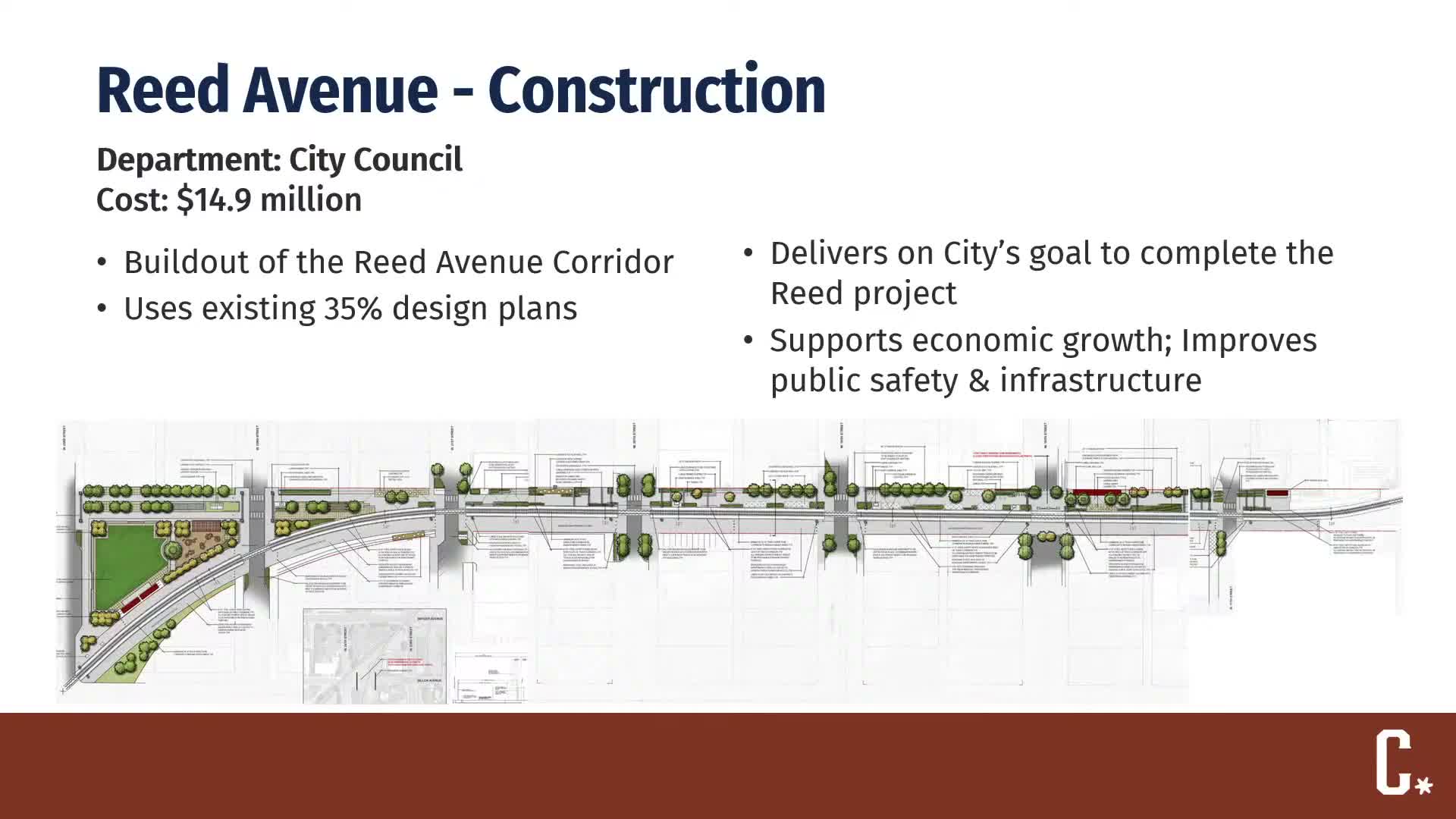
Summary
Supporters said recent design submittals and tentative BNSF engagement have moved the Reid Avenue corridor project forward; council heard that a Federal Railroad Administration grant of roughly $2.5M plus an $800K local match would fund grade crossing work while private investment could follow if public commitments are made.
The Reid Avenue corridor emerged as a focal point at the Dec. 10 Cheyenne public hearing as staff, investors and council members discussed recent technical milestones and grant leverage. Chair of the Reid Avenue steering committee, identified in council discussion as Chair Cobb, said the project reached a milestone by submitting a 30% design package to Burlington Northern Santa Fe (BNSF) for review and executing a professional engineering (PE) agreement that allowed the railroad to engage.
“It was a 30% submittal... this is the first time we were actually able to submit anything because we had to have a PE agreement with the railroad in order to move forward,” Cobb told the council, noting that senior BNSF staff had indicated they were prepared to let the project proceed toward higher‑level designs.
Investors and downtown stakeholders attending the hearing urged the council to use public investment to attract private capital. Dave Huebner, representing a group of investors, said his group used historical studies and community planning to justify the project’s potential and called Reid Avenue a catalyst for substantial future investment.
Staff and council members also described an FRA (Federal Railroad Administration) safety grant tied to the corridor. Cobb and staff outlined an FRA grant of approximately $2,500,000 with a local match of about $800,000 to fund grade crossing improvements (17th, 18th, 21st and Dillon), signalization, curb and gutter, islands and fencing. Councilmembers asked whether the grant and match would cover the estimated costs for the identified scope; Cobb said for the current 30% plan, those grant amounts appear sufficient for the identified items but cautioned final costs will depend on subsequent design and railroad concurrence.
Council members emphasized the railroad’s control over the corridor and warned that while BNSF has been more engaged recently, final concurrence is not guaranteed. “We have demonstrated everything to them, as much as we can go... I’m confident,” Cobb said, but he declined to promise absolute certainty that the railroad wouldn’t later require changes.
Supporters said public commitment could spur private investment. Sofia Mays, executive director of the Downtown Development Authority, told the council that a clear public commitment would unlock private interest and additional grants. Councilmembers acknowledged both potential economic payoff and the project’s complexity, including road closures and business impacts in phased designs.
Next steps identified during the hearing include refining designs to 60–90%, continued engagement with BNSF, and use of the FRA grant and prior city funds to advance safety elements. Council discussion indicated the city will consider phased approaches and prioritize safety‑critical elements as it balances the proposed 6p package with limited city ballot resources.