Get Full Government Meeting Transcripts, Videos, & Alerts Forever!
Get email alerts on the Public Safety topic
No spam. Unsubscribe anytime.
Residents press Las Cruces council on lead pipes, policing and crisis response
Summary
Multiple residents urged the council to address alleged misreporting of lead pipe inspections at Las Cruces Utilities, criticized the police chief's cooperation with federal authorities in recent arrests, and called for expanded crisis-intervention resources and oversight.
A series of public comments at the Dec. 1 Las Cruces City Council meeting pressed the city to take concrete steps on water safety, policing and mental-health crisis response.
Two speakers focused on Las Cruces Utilities' lead-service-line inventory. Lynn Moorerer told the council "there's no safe level of lead in drinking water" and alleged discrepancies between inspection numbers presented by utilities staff and the raw data; she urged the city manager to hire third-party engineering expertise to verify compliance with the EPA—s lead and copper rule. Another commenter (identified in the record as Rodriguez Johnson) presented handouts he said show the city using "installation date after lead ban" as a basis to classify service lines as non-lead, unknown or "unlikely lead," which he argued is inconsistent and misleading.
Separately, several speakers criticized recent actions by the Las Cruces Police Department. Lucas Herndon and Zach (District 2) questioned Chief Jeremy Story—s cooperation with federal authorities and warned that federalizing local cases can remove community oversight. Zach also raised concerns about expanding automated license-plate reader (ALPR) networks and regional data-sharing that could permit federal access to local ALPR data.
Liz Bennett, a licensed social worker, described the October police killing of Philip Mullen and said she believes untreated mental illness and standard police responses increase the risk of fatal encounters; she recommended the city pursue hiring social workers and reinforce crisis-intervention programs such as Project LITE.
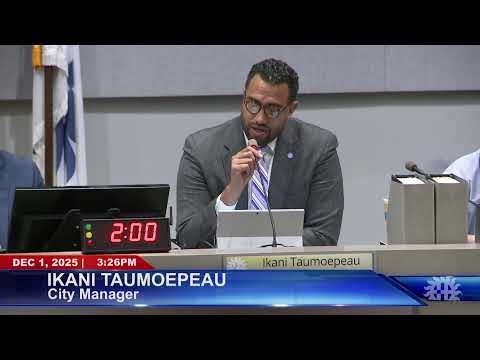
Council members took note; the city manager and staff later announced a coalition of stakeholders and a new public-health coordinator funded through a grant to evaluate mental-health, substance-use and homelessness responses, with an initial meeting scheduled for Dec. 11.
None of the public comments produced an immediate council action at the meeting, but speakers asked the council to direct the city manager and utilities leadership to audit the lead-service inventory, to clarify policies on federal referrals, and to accelerate funding and staffing for crisis-response alternatives.