
Las Cruces’ MIH and Light teams report reduced 911 reliance and plans to expand service hours
Get AI-powered insights, summaries, and transcripts
Subscribe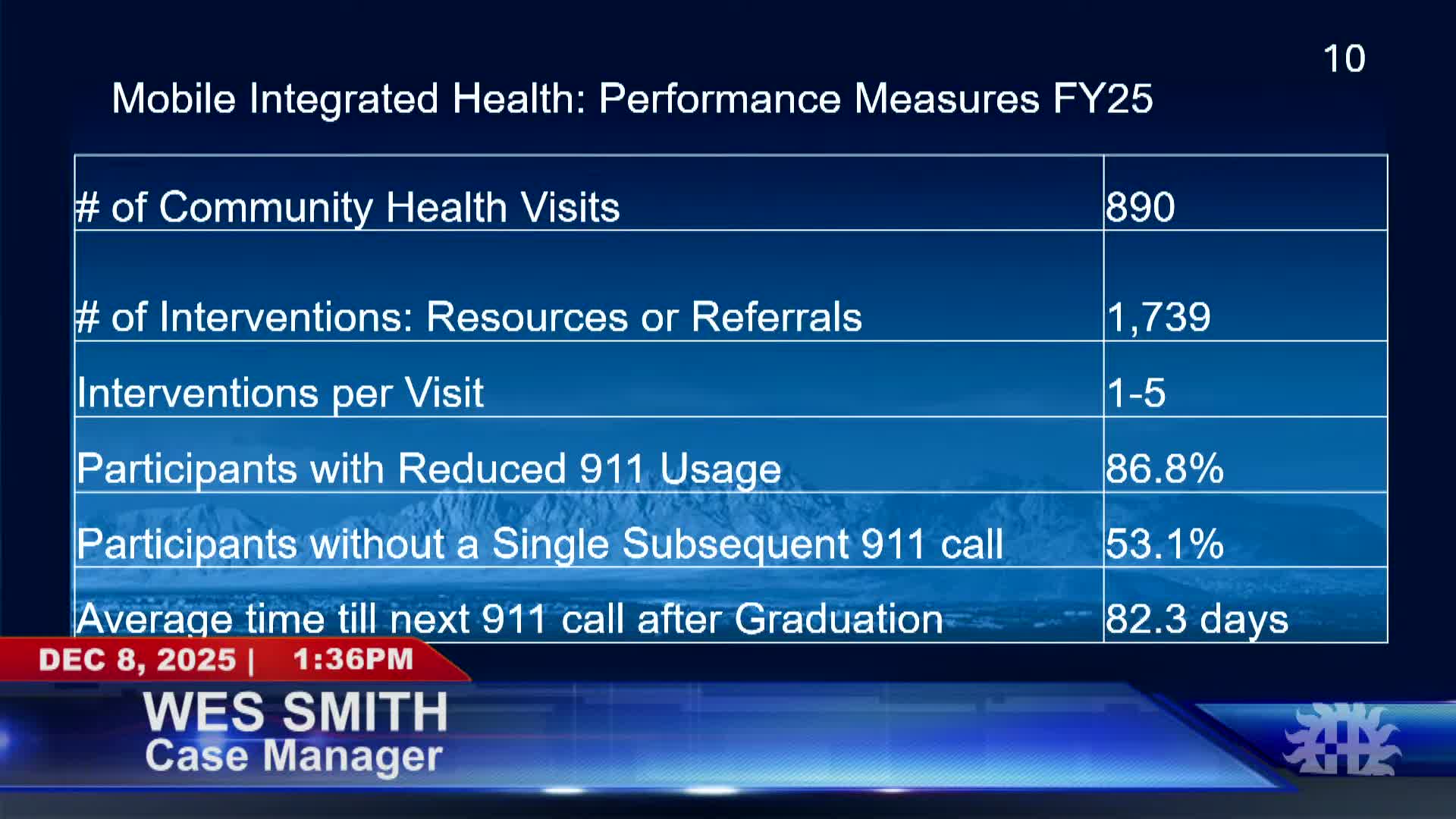
Summary
Fire‑department Mobile Integrated Health (MIH) and the Light mobile crisis teams reported FY25 results — 890 community visits, 1,739 interventions, a large share of patients with co‑occurring chronic and psychiatric conditions, and reductions in repeat 911 calls — and asked council to support expansions funded by HUD and legislative appropriations.
Wes Smith, case manager for the Las Cruces Fire Department’s Mobile Integrated Health (MIH) program, told the City Council Dec. 8 that the program has reduced emergency-department and 911 use among high‑need residents and is poised to expand services.
“An MIH referral can be found ineligible typically for three reasons: no MIH need, unable to locate the patient or they’re out of our jurisdiction, or safety concerns,” Smith said, describing program operations and limits. He said MIH served a wide age range, with an average patient near 70, and that ‘about 85 percent’ of patients carried both chronic medical and psychiatric diagnoses, creating complex needs requiring coordinated responses.
Smith provided outcome figures for fiscal year 2025: 890 separate community health visits, 1,739 interventions where staff either provided resources or made referrals, and an 86.8 percent overall reduction in 911 usage among patients worked with. He added that 53 percent of the patients served in FY25 had not made a subsequent 911 call as of Nov. 15, and that average time to any subsequent call was about 82 days.
Light, the city’s mobile crisis response, operates two co‑response teams composed of a firefighter‑paramedic and a licensed clinical social worker, daytime hours Monday through Saturday. Smith said Light treats many patients in place (the program’s goal) and diverts roughly 72.9 percent away from emergency‑department or detention transports.
Councilors praised the program and pressed for more capacity. Councilor Grant said the presentation “is clear justification for celebrating this program and expanding it,” and asked for strategies to reach a goal of responding to 90 percent of mental‑health crisis calls. Councilor Carrick and others asked about trends in call frequency and provider capacity for follow‑up; Smith said the program is sharing data with community partners to identify gaps and that recent staffing additions (a clinical supervisor and two new coordinators) will increase capacity.
A resident identified as Tara gave a personal testimony about using MIH and Vamos transportation for family caregiving, saying the services helped keep her parents out of the ER and supported survivor benefits and safety planning.
Smith said Light and MIH headquarters are funded through a combination of HUD grants, state legislative funds, and community partnerships, and reported approval for light social‑worker overtime in FY26 to expand service hours.