
Liberty Lake reviews multimodal transportation goals; commission flags e-bike safety and mapping needs
Get AI-powered insights, summaries, and transcripts
Subscribe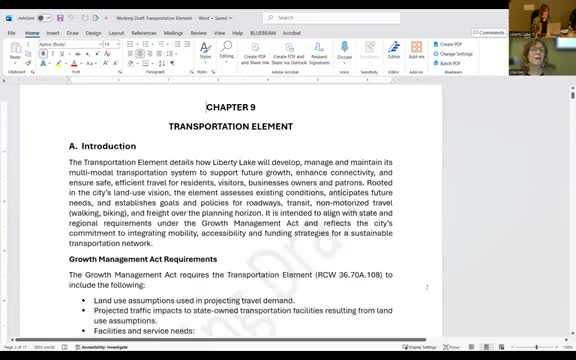
Summary
Planning staff presented multimodal transportation goals and policies; commissioners urged an outward-facing map of bike/golf-cart routes, discussed municipal-code changes to permit/require registration of e-bikes and golf carts, and asked staff to coordinate with police on safety and permitting.
Staff introduced the transportation chapter of the comprehensive plan, emphasizing a multimodal vision that requires bicycle, pedestrian and alternative-mobility facilities on collectors and arterials and allows a multimodal pathway in lieu of separate sidewalks and bike lanes.
Commissioners discussed publishing an outward-facing map for the public (bike lanes, sidewalks and permitted golf-cart/golf-cart routes) and whether code updates or permitting should precede public-facing materials. Committee members said existing GIS layers and sidewalk master-plan work could feed a public map; staff said some municipal-code changes (to address e-bikes and micro-mobility) and an education component would follow.
The group also focused on safety and regulation for e-bikes, e-scooters and low-speed vehicles. A staff member relayed that the Liberty Lake Police Department regards e-bikes and e-scooters as a significant current safety issue, raising the possibility of registration, permitting and age or speed limits. Chief Simmons was identified as the staff lead expected to bring a municipal-code proposal to city council in the new year.
Other topics included intersection level-of-service standards (signalized and unsignalized), roundabout capacity guidance, the city’s existing voluntary Harvard Road impact-fee program and the need to keep right-of-way and street-width policy flexible for multimodal accommodations. Staff outlined a timeline for finishing the sidewalk master plan and network analysis in January and integrating those products into the comprehensive plan.
Next steps: staff will continue mapping and code work, coordinate with the police department on micro-mobility recommendations, and present draft municipal-code language and maps to council and the commissions as items are ready.