
Southborough boards set path for special town meeting to study Neary options; roof to be separate warrant article
Get AI-powered insights, summaries, and transcripts
Subscribe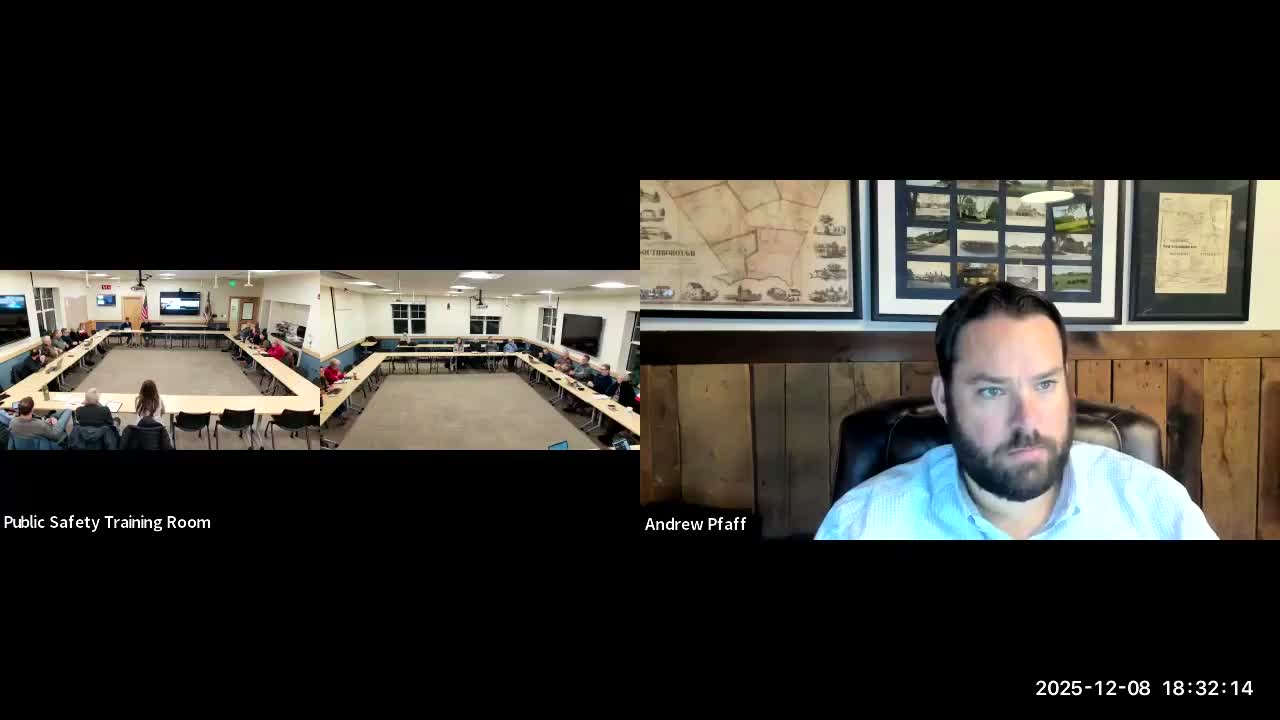
Summary
Select Board, School Committee and advisory panels agreed to ask voters to fund feasibility work on three school‑site options and to include a separate warrant article for a Neary roof, while members debated timing, financing guardrails and risks of funding a standalone roof.
At a joint meeting of the Town of Southborough’s Select Board, School Committee, Advisory Committee and the Capital & Infrastructure Planning Committee, members moved to bring three feasibility/schematic warrant articles and a separate article for a Neary roof to an upcoming special town meeting, saying voters need choices and clearer cost information before the town commits to long‑term construction.
The discussion centered on an urgent problem: Neary’s roof is leaking in classrooms and staff described instances of water intrusion that, one town official said, left “parents considering sending their kids to school with umbrellas.” Several parents who spoke during public comment echoed that urgency. Resident Ashley Kerwin, who said she volunteers in the building, called the conditions “offensive” to children and teachers and urged the boards to “get a new roof” even if a new building follows later.
Why it matters: board members said a standalone roof could be both necessary to keep the building safe and problematic politically and financially if voters believe the town will then continue to use Neary unchanged. Members repeatedly raised that a roof project could trigger Americans with Disabilities Act and fire‑suppression work depending on the cost and scope, which would raise the overall price tag. Board members and staff said they expect a firm selection on the roof cost estimate within weeks after a contractor is chosen from a pending request for qualifications.
What was agreed: the boards endorsed a working plan to bring feasibility funding and schematic design language for three options (variants discussed include renovating Neary, adding grades at Finn/Woodward, or pursuing an alternate site) and to include a separate article that would fund a roof replacement or repair at Neary. A motion reflecting that direction was made, seconded and carried during the meeting; members asked staff and the boards to refine language, cost caps or financing guardrails and the proposed special‑meeting date before the next meeting.
Debate highlights: some members said the roof should be advanced immediately to remove safety risk and restore a usable building; others warned that a roof alone could be a short‑term band‑aid that voids warranties or forces expensive ADA upgrades later. Board members and parents also raised alternatives such as modular classrooms (one figure cited for two years of modulars was approximately $2,000,000), and renovation cost ranges were discussed in general terms (some speakers referenced prior estimates ranging from mid‑single millions to figures cited as high as $16,000,000 for extensive renovation, but participants asked that firm numbers come from the contracted estimators).
Public input: parents and residents pressed the boards for timely action and clearer options. Mary (full name provided in the record) said she was “exhausted” by repeated discussions that do not produce answers and urged the boards to put multiple options before voters so the town can decide. Another resident, Rebecca Denti, said she feared that funding a roof now could be used to justify keeping Neary open indefinitely and requested that warrant language make the town’s intentions clear.
Next steps: staff reported that about 15 firms had responded to the RFQ and that site visits and contract selection were imminent; once a firm is under contract the town expects an order‑of‑magnitude roof cost within about 2–3 weeks. The Select Board asked staff to draft warrant language that reflects the three feasibility/schematic studies and a separate roof article, to clarify whether schematic design is required to produce reliable construction estimates, and to return with refined language and a recommended special‑meeting date at an upcoming meeting. The board also discussed the need for proactive public education before town meeting.
Action and procedural note: the meeting record shows a motion to pursue the special town meeting approach with the three option/study articles and a separate Neary roof article; the motion was seconded and advanced as the working direction for drafting warrant language. The boards adjourned at the close of the session.