THECB staff report ~82,000 transfer-course denials; launch transcript-processing review
Summary
THECB data staff reported nearly 82,000 reported course denials in the CBM-OOT dataset, with 'outside the degree requirement' the leading denial reason; staff will contact universities for rationale, investigate transcript-processing errors, and pursue consolidated reporting under SB 3039.
Agency analysts presented CBM-OOT (Senate Bill 25) data showing that in the most recent combined fall and spring submissions institutions reported nearly 82,000 course denials for transfer students, with the most common denial reason recorded as "outside the degree requirement." Christina Zavala, deputy assistant commissioner for data management and research, told the committee that roughly half of reported denials fall into that category, and about a quarter are attributed to not meeting minimum grade requirements.
"For our latest cohort, there were almost 82,000 courses that were reported as having been denied credit from transfer students," Zavala said, and staff highlighted top denied courses (college algebra, composition 1 and 2, learning-framework courses and U.S. history) and majors most affected (education, psychology, biology, computer science, accounting and nursing).
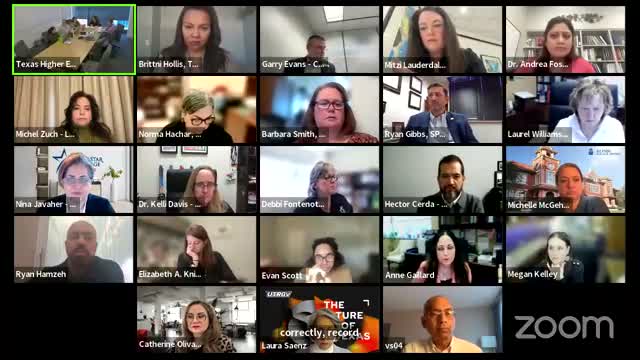
Britney Hollis described a parallel project to inventory how institutions process transcripts, identify missing data and determine how system and manual transcript issues affect credit mobility. Hollis said the first year of the project will focus on research, collecting institutional practices and identifying where transcripts omit critical ACGM coding or other record elements.
Members raised methodological questions: whether a course recorded as "denied for outside the degree requirement" might in practice have been applied as an elective at some institutions; whether dual-credit and associate-degree transfers are included; and how the manual submission rules prioritize multiple denial reasons when a course could meet more than one denial category. Staff acknowledged those ambiguities and said they would contact IR and academic-operations officials at specific universities to validate data and better align reporting practices.
Staff also described efforts to align reporting under the recently passed SB 3039 so the state can produce a consolidated transfer-reporting product on a regular cycle without adding new CBM reporting burdens. Next steps: staff will send institution-level queries to validate reasons for denials, develop guidance to help reporting officials prioritize denial reasons, and provide more detailed data back to community colleges so they can see which universities are denying particular courses.