
Clearwater presents Valley County fairgrounds master‑plan findings: strong attachments, infrastructure gaps and options for year‑round use
Get AI-powered insights, summaries, and transcripts
Subscribe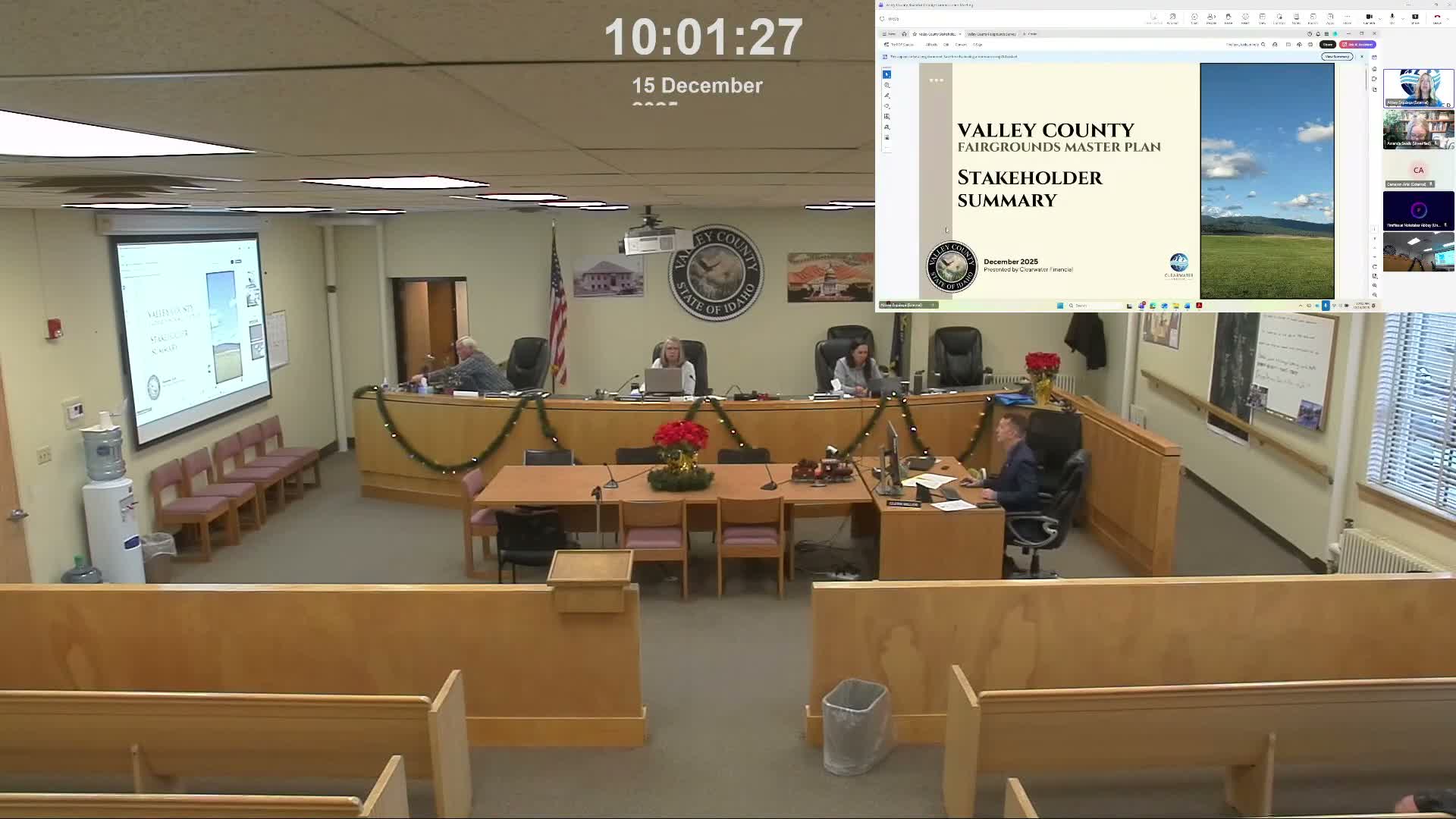
Summary
Consultants reported 19 stakeholder interviews and ~330 survey responses showing the fairgrounds are a cultural anchor, with strong support for youth agricultural programs and demand for year‑round, multipurpose facilities; parking, aging barns and limited utilities were the most cited infrastructure problems.
Consultants from Clearwater summarized input gathered this fall and over the summer for Valley County’s fairgrounds master plan, saying residents and regular users view the site as a cultural anchor that should retain agricultural traditions while expanding year‑round uses.
Abby, the Clearwater presenter, said the team conducted 19 confidential stakeholder interviews and collected more than 330 survey responses across the county. "The fairgrounds role is a cultural anchor for the entire county," Abby said, summarizing the interviews. The survey ran from June through Dec. 5 and drew a response rate the consultant described as “just under 3 percent” of Valley County, which the presenter called a healthy return for community surveys.
The nut graf: Clearwater identified clear strengths to build on — setting, recent arena improvements, volunteer engagement — but also consistent operational and physical constraints. Stakeholders and survey respondents repeatedly flagged aging barns, temporary livestock facilities, limited utilities, insufficient lighting, uneven surfaces, unclear pedestrian routes and poor parking and circulation during peak events.
The report said youth agricultural programs (4‑H and FFA), equestrian and rodeo activities are central to the fairgrounds’ purpose. Abby noted that stakeholders unanimously supported investment in youth programs but warned that limited bond capacity and aging infrastructure constrain participation and growth. Equestrian users specifically requested permanent infrastructure such as improved footing and additional stall space to reduce setup time and improve year‑round access.
Survey results mirrored the interview themes: the county’s physical conditions averaged 1.79 out of 4 in condition ratings, and 96 percent of respondents reported they had visited the fairgrounds. Respondents identified a range of facility needs including lighting, ADA access, signage, seating and restrooms; parking and trailer circulation were among the lowest‑scoring items.
Commissioners asked whether funding mechanisms had been discussed. Abby said the team has not yet presented funding options; Cameron, Clearwater’s project lead, said the scope already includes scenario development and the team intends to present three feasible scenarios (small, moderate and large) with economic and demographic impact analysis. The consultants estimated those scenarios would be ready for presentation in late January to early February.
The Valley County Fair Board plans a joint community meeting on Jan. 21 at 6 p.m. at the EEOC where Clearwater will present stakeholder and survey results for final community input.
What happens next: Clearwater will refine three scenario options and an economic/demographic report to inform the county’s decisions on scope and funding. No formal funding decision or bond proposal was presented at this meeting.