
Uvalde CISD holds TEA-required public hearing on school improvement plans; board presses for clearer parent outreach
Get AI-powered insights, summaries, and transcripts
Subscribe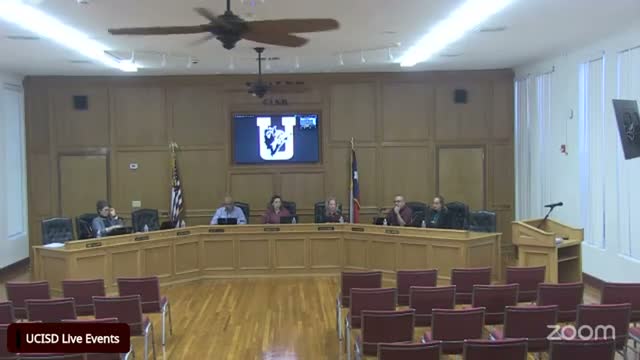
Summary
Uvalde Consolidated Independent School District held a public hearing on Targeted Improvement Plans (TIPs) and Turnaround Action Plans (TAPs) required by the Texas Education Agency; staff described required strategies, noted 66 stakeholder survey responses, and the board asked for simplified materials and broader outreach before TEA submission.
Uvalde Consolidated Independent School District (UVALDE CISD) trustees held a public hearing on Targeted Improvement Plans (TIPs) and Turnaround Action Plans (TAPs) required by the Texas Education Agency, with staff outlining campus strategies, assessment timelines and next steps for TEA review. Superintendent Collins introduced the meeting and turned the presentation over to Chief Instructional Officer Miss Krayber, who walked trustees through the district’s data‑driven approach and stakeholder engagement efforts.
Miss Krayber said the plans are framed around evidence‑based strategies selected from TEA’s required menu — primarily intensive curriculum and instruction, high‑quality instructional materials, data‑driven professional learning communities and regular coaching cycles — and that campus improvement teams used root‑cause analysis and multiple meetings to develop campus‑level actions. She said the district has been collecting feedback through campus meetings, QR codes and online forms and that staff have sent draft materials to TEA school‑improvement staff and Region 20 for feedback.
Board members pressed staff on parent outreach and the quality of stakeholder feedback. Miss Krayber reported the district received 66 survey responses to the plan presentations, a figure several trustees and community members called too small to guide decisions. One attendee urged aiming for a sample of 200 to better represent families. Trustees suggested practical steps to increase participation, including offering surveys during family nights, using Seesaw and direct phone calls for grandparents or households without technology, providing a condensed four‑page plain‑language summary for parents, and sending clear step‑by‑step instructions for accessing online materials.
The meeting included campus‑level presentations. Staff described Dalton Elementary’s status as a paired campus (pre‑K–2) that shares accountability with a tested campus and outlined screeners used by grade (Star Renaissance for grades 1–2; CLI Engage/TEX‑K for kindergarten; Circle/PM for pre‑K). Principals said beginning‑of‑year screeners are typically administered around September, with midyear tests in January and end‑of‑year assessments following; midyear data is used to identify students for Tier 2 and Tier 3 interventions, including in‑day tutoring.
Trustees also discussed operational changes to support teacher collaboration. At several campuses leaders proposed scheduling protected PLC time — often on Fridays — and aligning professional development so teachers have explicit, not ad hoc, collaborative minutes. Legacy and MJH leaders described PLC commitments and small but measurable domain gains at some campuses; MJH staff said they have targeted supports for special education and emergent bilingual students.
On process and timing, staff said TIPs (the one‑year plans for some campuses) are more adjustable, while TAPs (two‑year turnaround plans) are reviewed by the TEA commissioner as part of a formal approval process. Trustees and staff repeatedly described a compressed timeline to finalize plans; staff said the district had a narrow window after receiving notice (around Oct. 5) and that TEA had extended a submission date to the 20th, which left limited time for wider community engagement.
No formal votes on TIP/TAP approvals were taken at the hearing; the only recorded motion was procedural. Trustee Suarez moved to adjourn the public hearing, Trustee Russo seconded, the board voted unanimously and the meeting was adjourned.
What happens next: staff will refine plain‑language summaries for parents, expand opportunities to collect survey feedback at family events and through district channels, finalize TIP/TAP documents for TEA review, and continue campus monitoring using the scheduled assessments and PLC processes. Direct quotes in this report are drawn from the hearing record and attributed to the speakers who introduced them.