Get Full Government Meeting Transcripts, Videos, & Alerts Forever!
Get email alerts on the Assessments topic
No spam. Unsubscribe anytime.
Robla board reviews assessment data and a plan to move 'super-close' students to proficiency
Summary
At a board workshop, district curriculum leaders reviewed phonics, STAR reading, math benchmarks and English‑learner assessments and proposed targeting small groups of 'super-close' students to raise school-level proficiency percentages.
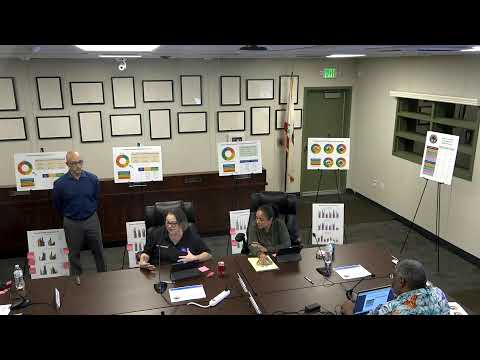
Mario Penman, the district’s director of curriculum and assessment, opened a board workshop reviewing three years of assessment data and urged trustees to use the figures to prioritize supports for students. "Board members, your ideas are important to us," Penman said as he framed the session around improved instructional decision‑making.
The presentation covered the district phonics survey for kindergarten and first grade (given at the beginning of the year, two trimesters and end‑of‑year), STAR Reading for grades 2–6 (administered quarterly via Renaissance) and math benchmarks administered across trimesters. Penman emphasized that some assessments are not directly comparable across grades; a principal clarified that the kindergarten phonics cut score differs from the first‑grade cut score, so proficiency percentages cannot be read as a straight cohort comparison.
On English learners, Director Lyon described an ELFA formative rubric the district created to capture listening and speaking data that the summative ELPAC does not show. "The ELFA assessment is an English language formative assessment, and this is an assessment we created here within Robla," Lyon said, adding that the district lacks a way to upload rubric‑style results into the current student‑information system.
Penman proposed a targeted strategy: identify the top third of students in the 'nearly met' category—the 'super‑close' group—and deliver focused interventions to move a modest number of students into proficiency. He gave examples from the packet showing that moving about 19 fourth‑grade students a few questions closer to proficiency could raise a school’s fourth‑grade proficiency from 22% to 29%; similar small moves in other grades would yield comparable percentage increases.
Trustees pressed for deeper disaggregation by cohort, teacher assignment and student group to explain a district‑wide dip in 2023–24. Penman said leadership will "dig deeper" and return with more granular data; trustees requested that student‑group breakdowns and chronic‑absenteeism metrics be shown in a district dashboard presentation scheduled for December.
The board did not take formal action on curriculum adoption at the workshop but was told a math‑adoption review of state‑approved vendors is planned for the fall and county curriculum previews are scheduled in December.
Next steps: leadership committed to follow up with school‑level and cohort analyses and to present dashboard breakdowns to the board in December.