
East Valley Academy students urge board to ease strict attendance and ID rules
Get AI-powered insights, summaries, and transcripts
Subscribe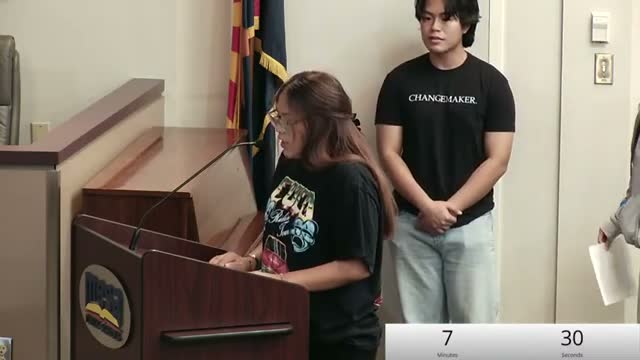
Summary
Two East Valley Academy students told the Mesa Public Schools Governing Board that the school's five‑day‑per‑quarter attendance limit and rigid ID enforcement harm learning and asked for more flexibility, including appeal days and temporary ID passes.
Shelby Roanhorse and Cameron Williams, high school students from East Valley Academy, told the Mesa Public Schools Governing Board on Dec. 11 that school policies on attendance and student identification are too strict and can cause students to lose credit or face punishment for honest mistakes.
Roanhorse said East Valley enforces a five‑day absence limit per quarter that is stricter than district practice, and that she lost the ability to earn credit after exceeding the limit for medical reasons. “Our school's attendance policy is not the same as the district's or the state's,” she said, adding that the rule leaves students with “no opportunity to earn credit” when circumstances beyond their control occur.
Williams described frequent, stressful encounters at the school gate when students forget their IDs. He proposed several changes aimed at preserving campus safety while reducing punitive outcomes: a grace period, one free temporary ID per quarter, the ability to issue a quick temporary pass at the gate, or a phone call to a parent so the student can retrieve an ID instead of being barred entry.
Board members asked students to explain details of their proposals during a brief question-and-answer exchange. Members confirmed Roanhorse's statement that East Valley's five‑day limit is applied per quarter and asked whether medical exceptions exist; Roanhorse said the current consequence for missing more than five days is the inability to earn course credit. On ID policy, board members discussed options including printing same‑day temporary IDs or issuing temporary electronic passes at check‑in.
The board praised the students for participating in a Read Better, Be Better civic leadership program that prepared them to present proposals and emphasized that staff and community partners, including Member Hutchinson and program staff, assisted in preparing their remarks. There was no formal board action tied directly to the student presentations during the meeting; board members said they would consider the proposals as part of broader policy and operational reviews.
The students' presentations came during a study session component of the meeting that the board used to showcase partners and student civic work before moving on to the regular meeting agenda.