
Lake Stevens holds parliamentary-procedure workshop; participants practice motions and public-comment rules
Get AI-powered insights, summaries, and transcripts
Subscribe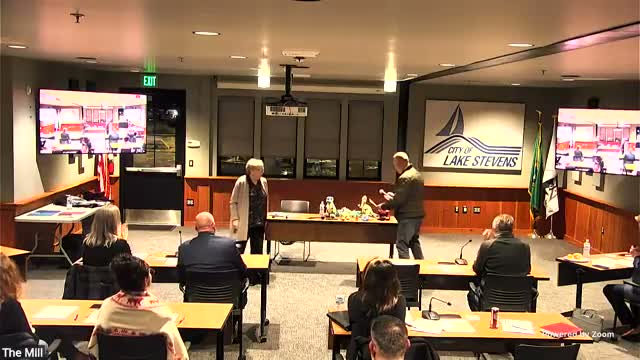
Summary
Trainer Anne McFarland led Lake Stevens officials and volunteers through Robert's Rules, points of order and appeals, motions and amendments, and public-comment best practices. Participants practiced with role-played motions, including an exercise on a simulated surplus that was amended and adopted in the training scenario.
Anne McFarland, founder of Jurassic Parliament, led a Lake Stevens training session for city council members, commissioners and staff on running orderly public meetings, emphasizing Robert's Rules of Order, points of order and appeal, and managing public comment.
McFarland told attendees that the core aim was to "invigorate you to run effective city council, commission, and committee meetings," and she repeatedly emphasized the group’s authority over any single individual. She urged practical steps such as reading agenda packets in advance, using action-oriented minutes, and having the chair restate motions so everyone knows what is being voted on.
The workshop covered specific procedures the city can use in meetings. McFarland highlighted a basic fairness rule: "No one may speak a second time until everyone who wishes to do so has spoken once," and recommended tools such as speaking charts and round-robin turns to ensure broad participation. She noted that for a seven-seat body the quorum is a majority — four members — and recommended action or summary minutes that record decisions rather than verbatim discussion.
Participants rehearsed a scripted "pickle festival" scenario to practice spotting decorum problems and raising points of order. McFarland defined a point of order as a motion that a procedural mistake has been made and said it must be raised at the time of the infraction. She also explained appeal procedures, noting Lake Stevens' unusual rule that appeals may go to the attorney under the city's current rules, while standard Robert's Rules practice leaves such rulings to the group.
The class moved from instruction to role-play on motions and amendments. McFarland walked the group through an eight-step sequence for handling motions: a member makes the motion, another seconds it, the chair states the motion, members debate and may amend, the chair restates the motion, members vote, the chair announces the result and any follow-up. She also explained that "call the question" requires a two-thirds vote to stop debate and that unanimous consent can be used to adopt noncontroversial changes quickly.
In a mock council exercise, participants debated a simulated proposal to create life-size dinosaur replicas; that initial motion failed. Later in a separate exercise about an unexplained budget surplus, a participant identifying himself as "Mister Enemy" moved to hire an outside consultant to examine the surplus, saying, "We need to figure this out." Another participant, identified in the exercise as the "dentist," moved to amend the motion to have staff investigate instead; that amendment passed in the simulation (the facilitator recorded a 7–3 vote on one amendment). A subsequent amendment to suspend spending until the probe concluded initially failed but passed after a division, and workshop facilitators treated the final result as part of the training exercise rather than a binding council action.
McFarland devoted substantial time to public-comment policy. She distinguished formal quasi-judicial hearings (which create an administrative record) from general public-comment periods and advised councils to avoid back-and-forth dialogue from the dais during comment periods. Recommended practices included announcing time limits at the start of a session, using visible timers, and structuring large debates (for example, splitting 30 minutes into equal pro/con blocks). She warned that overly broad restrictions on speech can invite First Amendment challenges.
Throughout the session McFarland emphasized civility and chairing style: phrase matters in the positive, avoid personalizing enforcement (use third-party language), and when in doubt turn the question to the group. She closed by promising to distribute handouts and templates, including a quick two-page guide, and encouraged participants to adopt and adapt the practices presented.
The workshop was educational and interactive; no formal city decisions were taken as part of the training. McFarland said materials and a packet of reference documents would be distributed to attendees for follow-up.