
St. Louis Park adopts 2026 budget, keeps HRA levy at $1.194 million after close 4–3 vote
Get AI-powered insights, summaries, and transcripts
Subscribe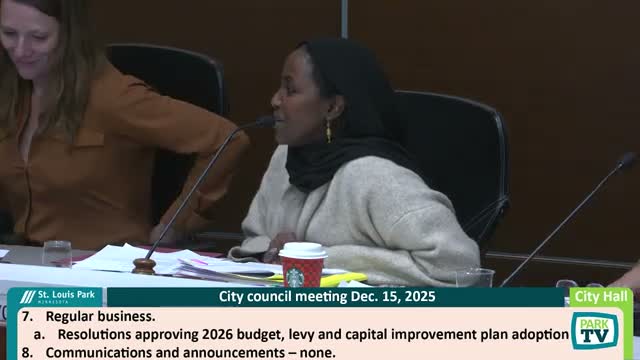
Summary
St. Louis Park’s City Council approved the 2026 budget and related levies on Dec. 15, retaining an HRA levy of $1,194,133 after a 4–3 vote following public comment and extended council debate over tax relief versus preserving affordable-housing funds.
St. Louis Park’s City Council on Dec. 15 adopted the city’s 2026 budget and authorized final property tax levies, including a Housing and Redevelopment Authority (HRA) levy of $1,194,133 — unchanged from 2025 — after a 4–3 vote.
Finance Director Amelia Kruger summarized the budget before the vote, saying the package fully funds the new Minnesota Paid Family and Medical Leave program, balances internal service funds, supports a free brush management site for residents and provides ongoing funding for the city’s Climate Investment Fund. Kruger said staff had reduced departmental budgets by more than $200,000 and decertified some TIF districts to lower the levy impact on residents.
“On November 17 the overall levy increase was lowered from 8.02% to 7.49%,” Kruger said during the presentation, and she noted using older data made earlier homeowner impact estimates conservative. Using that data, she said, the median homesteaded homeowner would have felt about an 8.6% increase; staff said subsequent actions (TIF decertifications and levy adjustments) should reduce the actual impact.
The narrowest part of the council debate centered on the HRA levy, which funds the Affordable Housing Trust Fund and the city’s capacity to make loans, grants and other interventions for affordable housing. Council members weighing a reduction argued that lowering the HRA levy by roughly $500,000 (to about $700,000) would provide modest direct tax relief to homeowners this year and could be absorbed because the trust fund’s cash balance was healthy. Opponents said reducing stable, recurring HRA revenue would hamstring the city’s ability to act on urgent affordable-housing preservation and development opportunities and could cause higher tax or funding pressure in later years.
“Reducing this levy to $600,000 or $700,000 will result in substantially reducing the available fund balance over time to levels that make it difficult for housing staff to avail itself of opportunities as they do arise,” one council member said while urging colleagues to maintain the levy at current levels.
During public comment, resident Antonio Sassin identified himself as an international migrant recently laid off and urged the council to reduce the HRA levy to provide immediate tax relief. “An 8% increase is not just a number to me,” Sassin said. “It’s a displacement, potentially.”
Council members noted trade-offs. Supporters of holding the HRA levy at the 2025 level said the fund enables the city to make million-dollar loans and to respond quickly to preservation needs; staff pointed to prior-year commitments such as a $1 million loan for Terraza and a $1.8 million loan for the BeltLine station as examples of programmatic spending that will draw on the fund.
Council members who supported lowering the levy emphasized resident hardship and the fund’s current balance. Staff modeling, Kruger said, suggested leaving the levy at $700,000 over five years would reduce the fund balance to roughly $3 million — above the city’s minimum policy level but more constrained for new discretionary programs.
After roughly an hour of discussion and several separate motions, a motion to adopt the final 2026 HRA levy at $1,194,133 passed on a 4–3 vote. The council then approved the final EDA levy and the larger budget and capital improvement plan (2026–2035) in subsequent votes; the council chair and staff recorded the motions and tallies during the meeting.
The adopted budget maintains funding for affordable housing programs and capital projects while staff said they will continue to monitor conditions and return to levy and program decisions in future budget cycles. The council’s next steps include implementing the adopted spending plan and monitoring whether changes at other taxing jurisdictions (county, school district) alter the overall tax impact on residents.
The council adjourned the city meeting and immediately transitioned to the Economic Development Authority meeting to ratify levies related to the EDA and HRA.