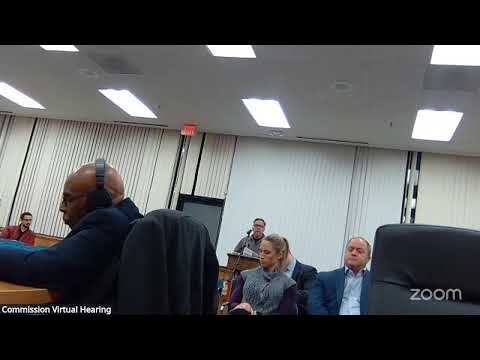
Bel Air residents urge PSC to reject Maryland American’s two-tier rate and fast-pass cost recovery
Loading...
Summary
At a Public Service Commission hearing in Bel Air, residents, town commissioners and local officials urged the commission to reject Maryland American Water Company’s proposed two-tier usage rate and semiannual cost-recovery riders, saying the proposal shifts costs to ratepayers, lacks means-testing data, and risks undermining regulatory oversight.
Bel Air residents and elected town commissioners told the Maryland Public Service Commission on Monday that Maryland American Water Company’s proposed rate increase — which includes a two-tier usage structure and semiannual cost-recovery riders — would unfairly shift costs to customers and lacks the data needed to justify socalled means-based targeting.
"There is no data that has been provided by Maryland American that shows that using less water means that you have a lower income," said Paula Edding, chair of the Bel Air Town Commissioners, in public comment opposing the tiered proposal and describing town cost impacts, including higher hydrant charges.
The hearing brought a string of similar concerns from municipal officials and residents. Jake Taylor, a Bel Air commissioner, said the company "has no way of means testing their customers" and argued the tiered structure would "punish those who use more water," disproportionately affecting larger households. Thomas Lipka, a local business owner, said his calculation showed Bel Air customers already pay above national averages and called the proposed increase "plain and simple."
Several speakers focused on provisions that would allow Maryland American to recover certain costs between general rate cases. Gavin Hanley, a newly elected Bel Air commissioner, warned that the proposed advanced treatment and compliance rider (ATCR) and the distribution system infrastructure charge (DSIC) would "shift significant risk from the company to ratepayers," reduce the role of traditional test-year ratemaking and could erode PSC oversight of capital spending.
"The ATCR is projected to add $16.68 to the typical residence bill in the next 2 years," Hanley said, citing the company’s projections; he also noted the company expects state funding for PFAS work and questioned why that should not be prioritized before passing costs to customers.
Blaise Sedney, a CPA and chair of Harco Credit Union, pressed the commissioners to examine corporate-level profit flows and affiliated-company charges. Sedney cited a publicly stated corporate-level after-tax profit margin of about 22% at American Water Works Company and asked how much of Maryland American’s expense is paid to affiliated service companies and then passed upstream as profit.
"They are taking the money from the ratepayers and giving it to the shareholders," Sedney said, urging review of dividend flows and debt-versus-equity assumptions used in setting the utility’s return.
Speakers also raised accounting and timing questions. Steven Chizmar, a town commissioner, asked why loans issued before 2019 appear in materials for the present test year, pointed to an in-service expenditures spike in 2025 "to over $7,000,000" in the filing, and sought clarity on whether meter replacements will be funded through the DSIC or recovered in the general rate base.
Members of the public urged the PSC to scrutinize nonrevenue water (losses) and recommended the company reduce leakage from the system before seeking broader cost recovery; Chizmar said the company reported roughly 15% nonrevenue water and urged that figure be reduced.
Maryland American’s counsel, Max Cook, introduced company witnesses at the start of the hearing but did not make a substantive presentation to rebut these claims during the public-comment portion. Kenneth Albert of PSC staff said staff will present technical testimony and participate in the evidentiary hearing scheduled for January.
Chair Fred Hoover closed the hearing by reminding attendees that comments and any additional filings submitted to the docket will become part of the record the commission considers in reaching a decision next year and then adjourned the session.
What happens next: PSC staff will analyze testimony, evidentiary filings and public comments as part of the record; the commission said it expects to issue a decision in the company’s rate case next year. The docket remains open for supplemental filings through the PSC filing procedures.