
Airport plans frequency change; FCC timing could delay chart‑supplement update
Get AI-powered insights, summaries, and transcripts
Subscribe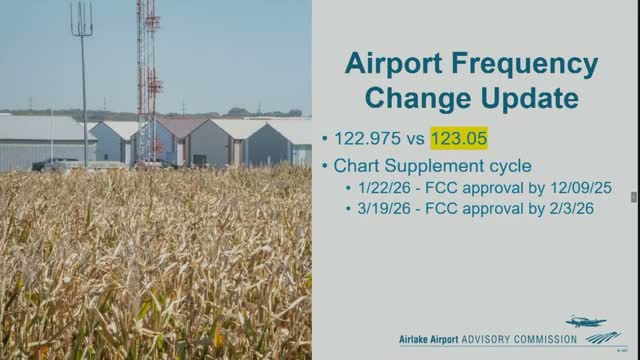
Summary
Airport staff proposed changing the common traffic advisory frequency to reduce overlap with nearby airports; staff said FCC approval by Dec. 9 is needed for a Jan. 22 chart supplement update, otherwise the next available cycle is March 19.
Sam Seefeldt, the airport manager, told the AAALAC that the airport has been working for more than a year to change the common traffic advisory frequency from the widely used '123' to an alternative to reduce interference from nearby fields.
"We're currently on 1 23," Seefeldt said. He described data‑driven consideration of alternative frequencies — references in the discussion included 122.975 and 123.05 — and said the ALAC recommended changing frequencies after staff reviewed operations counts at nearby airports.
Seefeldt explained the regulatory timeline: to appear in the Jan. 22 chart supplement the FCC must approve the change by Dec. 9 so the airport can meet the Dec. 10 submission deadline. Missing that window would push the change to the next chart cycle, with a Feb. 3 submission for a March 19 effective chart update.
Members asked how the airport will alert pilots. Seefeldt said the airport will use a NOTAM, automated weather messages (AWOS), newsletters and signage at airport entryways, and other outreach. He also noted that State Aeronautics will need to order new cards for the pilot‑controlled lighting system so the lighting keys properly to the new frequency.
Seefeldt said the change should improve safety in the traffic pattern by reducing overlapping traffic on the advisory frequency; members expressed support and urged staff to move the change as quickly as possible.
What happens next: The airport awaits FCC approval; staff will publish NOTAMs and coordinate outreach if and when the FCC grants the frequency change.