Get Full Government Meeting Transcripts, Videos, & Alerts Forever!
Get email alerts on the Open Government topic
No spam. Unsubscribe anytime.
Board Attorney Trains Cromwell Members on FOIA, Executive Sessions and Confidentiality
Summary
Attorney Jessica Ritter led a governance training for Cromwell Board of Education members, emphasizing that board action must be public under Connecticut's open-meetings rules, explaining limits on executive sessions, and warning that written communications and texts about board business are subject to FOIA.
Jessica Ritter, an attorney from the Shipman firm, led a training for the Cromwell Board of Education on members' legal responsibilities, open-meeting rules and confidentiality.
Ritter told members their primary duty is to "look at what is in the best educational interest of our students" and emphasized that board members act as a unified body rather than as individual supervisors. She advised against individual board members contacting or directing district staff about operational matters and said concerns should be routed through the superintendent and the board chair. Ritter described the superintendent (referred to in the transcript as Dr. Macri) as the district's chief executive and the single employee the board evaluates.
On public-records law, Ritter summarized Connecticut's Freedom of Information Act principle: the public has a broad right of access and most board business should be conducted openly. She warned that written or electronic communications can trigger FOIA requests and produce large document sets, advising members, "Do not put anything in writing." Ritter reviewed meeting-notice requirements (regular meeting schedules filed annually; agendas generally require 24 hours' notice; remote meetings require 48 hours) and said minutes must be available within seven days.
Ritter explained executive sessions are a narrow exception to public meetings and may be used for attorney-client communications, personnel matters (appointment, employment, performance, health, termination), confidential student records (e.g., expulsion hearings), security strategy and named pending litigation. She cautioned that the law requires sufficiently specific agenda language when invoking an executive-session exception. Ritter also reviewed an example FOI Commission matter and an example of an unfair labor charge that followed a board member's intimidatory conduct toward a principal to illustrate legal and resource risks.
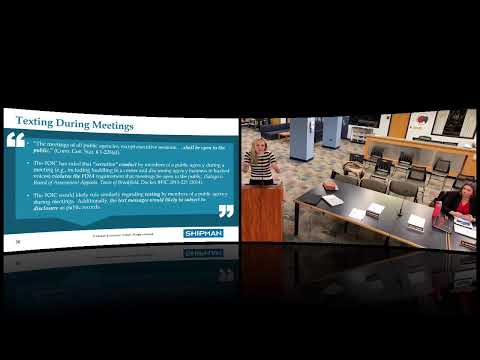
She walked through a hypothetical in which a reporter seeks text messages exchanged by board members during a budget discussion and said such messages are subject to disclosure if they relate to board business even when exchanged on personal devices. Ritter recommended funneling data and information requests through the board chair to manage volume and staff workload; board members agreed to refer a bylaw change on direct administrator contact to the policy committee for follow-up.
The training included repeated procedural reminders and closed with an offer to answer further questions or to return for additional sessions. The transcript does not record any policy changes adopted at the meeting; it records the training and the board's decision to place a bylaws review on a future policy committee agenda.