
Greater Lowell students unveil winning WBLA urban aquaponics proposal to feed local families
Get AI-powered insights, summaries, and transcripts
Subscribe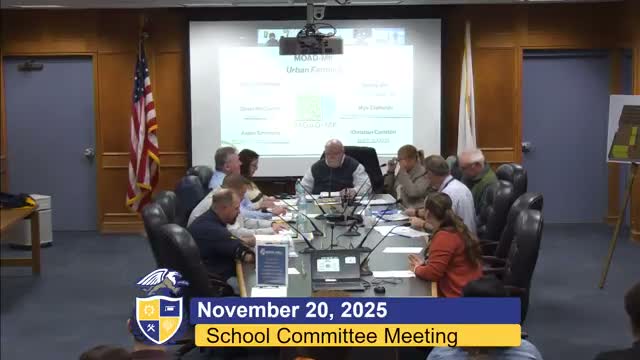
Summary
Students from Greater Lowell Regional Vocational Technical presented a winning WBLA design-challenge project proposing a 6,000 sq. ft. urban aquaponics farm with vertical growing, solar power and a CSA model; presenters gave technical, budget and outreach details and answered committee questions.
A team of Greater Lowell Regional Vocational Technical students on Thursday presented their WBLA design-challenge winning proposal for a 6,000-square-foot urban aquaponics farm aimed at improving affordability, access and nutrition for Lowell residents.
The group, calling themselves ModeMK, described a compact downtown site with twelve vertical growing towers, a greenhouse with an aquaponics system, a small chicken coop and a shed with six solar panels. "Affordable food, accessibility, and nutrition are hard to obtain, especially for the citizens that are struggling to get by in Lowell," the team said during the presentation. They said the farm would run year-round on solar during the day and generators at night.
Teacher Robin Tillum, who coordinated the students’ WBLA participation, said the project grew out of a design challenge that connects students with industry mentors. "We were approached by WBLA, to be invited as part of this challenge…this is our third year in a row working with WBLA," Tillum said, citing industry partnerships and internships that supported student learning.
ModeMK gave technical and operational details: four 2,000-gallon tanks (one dedicated nursery), vertical farms stacked to save space, a water-pump recirculation system that feeds plant grow containers from fish tanks, and filtration including a solid-waste filter and biofilter. Students reported power requirements around 3.2 kilowatt-hours for heaters, lights and ventilation in their prototype calculations.
On finances, the presenters called themselves a nonprofit and said the original total estimated budget had been $100,000; they reported spending about $52,000 so far, with construction and housing costs around $37,000 and a $10,000 contingency. ModeMK said annual staffing operating costs were estimated between $47,000 and $62,000 and projected CSA income between roughly $62,000 and $87,000 depending on membership levels and seasons. The students described two CSA options — a biannual share (summer/ winter) and a monthly $125 option — and optional egg-upgrade add-ons.
The team described community partnerships with Mill City Grows, industry engineers and school teachers, and said they hope to partner with Lowell Public Schools and local small businesses for distribution and educational outreach. They told the committee they aim to feed "over 75 families monthly by the end of 5 years." When asked where the farm would go, presenters said the proposal envisioned an empty lot downtown but could be adapted if a school-site opportunity were available.
Committee members and staff complimented the students’ work. The presentation included a short video of the proposal and a question-and-answer exchange in which presenters explained their CAD layout, community-supported agriculture model and industry supports.
The board took no formal action on siting or funding the project during the meeting; the presentation was delivered as a student showcase tied to the WBLA competition.
The committee meeting continued with other agenda items after the students' presentation, including grants and the MCAS accountability briefing.