
Columbia council advances short‑term rental zoning amendment after hours of public comment
Get AI-powered insights, summaries, and transcripts
Subscribe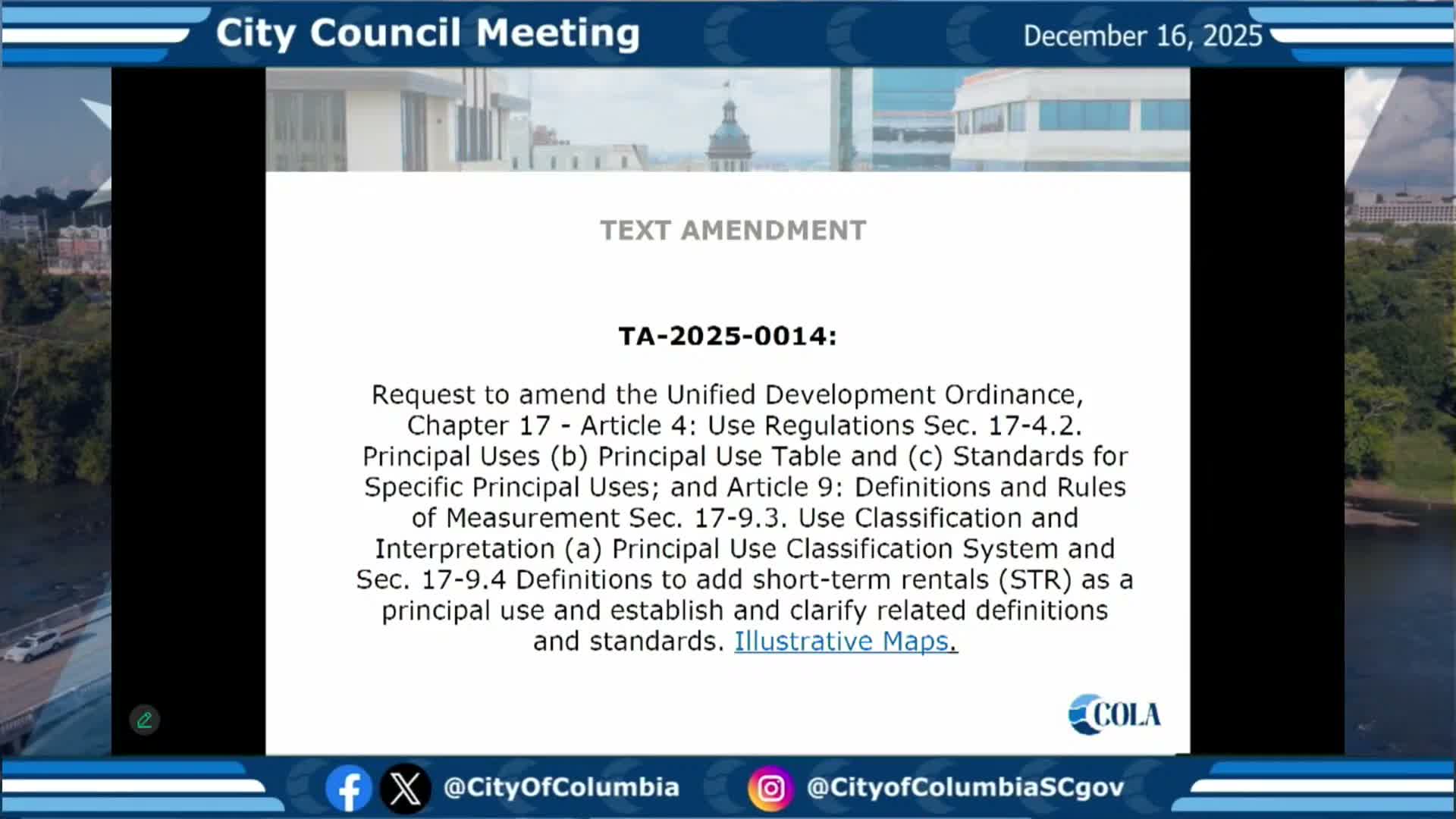
Summary
After hours of testimony from homeowners, hosts and neighborhood groups, Columbia City Council voted to advance a text amendment that would restrict new short‑term rentals in most residential areas and allow them in commercial and major arterial corridors, with council directing legal staff to refine owner‑occupied exceptions.
Columbia City Council moved forward on first reading with a proposed change to the city’s Unified Development Ordinance that would significantly limit where short‑term rentals (STRs) can operate in the city.
The ordinance draft, presented by planning staff, would allow STRs in commercial, mixed‑use and employment districts and permit them conditionally in residential areas only on collector or arterial streets that have four continuous travel lanes. Council also directed legal and planning staff to address an owner‑occupied exemption and other technical edits before a second reading.
The measure drew a sustained public response. Katie Grubbs, a Columbia resident and realtor, told the council the proposal “goes much further than addressing bad actors,” saying owner‑occupied residents rely on occasional STR income for transitions, family events and short work assignments. “Short term rentals in Columbia aren't just used by investors,” Grubbs said. Several neighborhood speakers, including Laurel Pinkley of Earlwood, urged stricter limits, citing a November shooting near an unpermitted STR: “We can't sacrifice community and safety for businesses,” Pinkley said.
Neighborhood organizations such as ECHO (Earlwood Community Citizens Organization) presented survey data to show concentrations of STRs in some neighborhoods and argued that growth is eroding residential character. Opposing testimony from hosts, local property managers and the Central Carolina Realtors Association warned that a broad zoning ban would penalize owner‑operators and reduce housing‑market flexibility.
City staff described the draft as a tool to prevent commercial, hotel‑style operations from proliferating in single‑family neighborhoods while preserving STRs in business corridors and mixed‑use areas. The council's first‑reading motion passed with the roll call recorded as: Bailey Aye; Brown Aye; Dr. Aditi Bustles Aye; Brennan Yes; McDowell Yes; Mayor Rickman Aye. The council emphasized that the homeownership carve‑out would be revised following legal review and additional outreach.
Next steps: staff will work with the city attorney to clarify owner‑occupied allowances, finalize definitions and return the ordinance for a subsequent reading and additional public notice.