
Charlottesville BAR denies large 7th Street development, citing incompatibility with adjacent protected cottages
Get AI-powered insights, summaries, and transcripts
Subscribe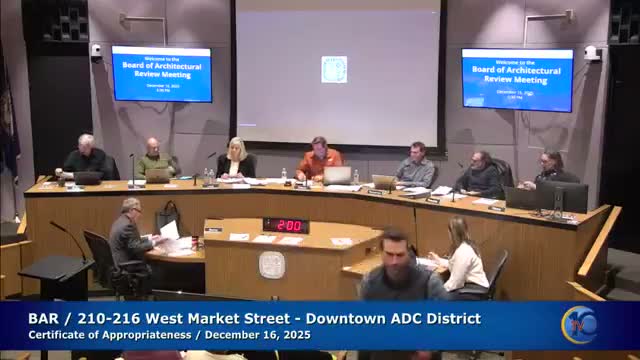
Summary
The Board of Architectural Review voted 6–1 to deny a certificate of appropriateness for a seven‑story development on the 200 block of 7th Street SW, finding the project's scale, massing and material choices incompatible with two individually protected properties at 204 and 208 7th Street SW.
The Charlottesville Board of Architectural Review voted 6–1 to deny a certificate of appropriateness for a proposed development on the 200 block of 7th Street SW after concluding the project’s size and massing were not compatible with two individually protected properties at 204 and 208 7th Street SW. The board’s motion cited the design guidelines’ criteria on material, texture, color, height, scale, mass and placement as the basis for denial.
The denial came after more than an hour of public comment in which neighbors and local activists described the project as a risk to the Fifeville neighborhood’s historic character and longtime residents. Resident Shanti Levy said the plan would remove ‘‘45 large trees’’ and replace forested areas with a narrow pool and terrace area she described as a private amenity, arguing that the project ‘‘locks the fabric of our city into a particular market moment.’’ James Carr, joining by phone, told the board the development would ‘‘block out’’ the sky and trees directly in front of his home and urged the BAR to consider broader neighborhood impacts.
Staff explained the BAR’s narrow legal purview: the board is charged to judge compatibility with the IPPs under the city’s design guidelines and not to revisit zoning. Staff also briefed the board that recent zoning changes allow greater height and density in much of the area, creating a practical tension between the zoning map and the BAR’s preservation guidelines.
Applicant representatives defended the design and pointed to changes made after prior BAR reviews—stepping back massing from the street, lowering rooftop units and adding a two‑story brick base to relate to the cottages. John Matthews of Michonne Matthews Architects said the project ‘‘rehabilitates and protects the IPPs’’ and that the team had adjusted material palettes and plantings in response to BAR feedback. A developer representative noted the project is expected to contribute roughly $4 million and produce about $1 million in first‑year tax revenue for the city.
Board members who opposed approval said those adjustments were insufficient. One member said the project’s massing ‘‘dwarfs the cottages, the streets, the entire neighborhood’’ and that the symbolic impact of a large blocklike building was unacceptable in this setting. Members who supported denial noted that while the proposed rehabilitation of the cottages was welcome, the larger building’s scale created an adverse effect on adjacent properties that could not be reconciled under the BAR’s criteria.
After debate, the board adopted a motion finding the proposed development ‘‘does not satisfy the BAR’s criteria and guidelines’’ for compatibility with the two IPPs and denied the COA by a 6–1 vote. Staff read the next steps: an appeal to city council can be filed in writing within 10 business days with the required fee, at which point council will take up the matter. The BAR chair encouraged residents to contact city councilors and consider neighborhood options such as pursuing a conservation overlay or local designation.
The denial leaves the applicant able to appeal to city council or revise the proposal and return to the BAR. The city staff noted that if the developer chooses to revise the design and request a deferral or a new hearing, the BAR and staff will work with the applicant on possible changes—members repeatedly mentioned reduced height, increased setbacks and breaking the mass into smaller volumes as potential paths to better compatibility.