Get Full Government Meeting Transcripts, Videos, & Alerts Forever!
Get email alerts on the Ethics Code Revision topic
No spam. Unsubscribe anytime.
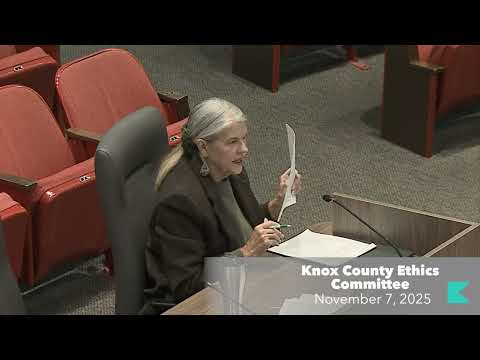
Knox County ethics subcommittee reviews redlined code; legal counsel cautions on authority and free-speech limits
Summary
At a Nov. 7 meeting the Knox County Ethics Subcommittee reviewed a redline draft of the county code of ethics, discussed expanded conflict disclosures, gifts, travel limits, nepotism, social-media rules and whistleblower reporting, and agreed to seek law department review before returning Dec. 3.
The Knox County Ethics Committee Subcommittee met Friday morning to review a redline draft of the county Code of Ethics and to discuss a package of proposed additions ranging from expanded disclosure requirements to social-media and whistleblower provisions.
The meeting, convened at 8:30 a.m., was largely a working session: committee members discussed about eight or nine suggested changes but made no final policy decisions. The panel approved the October minutes and agreed to continue review at a Dec. 3 meeting; members asked the law department to provide a formal opinion before the subcommittee forwards recommendations to the full county commission.
The redline draft presented by the chair retains the current code (shown in black) and marks proposed additions in red. Key proposals discussed included broadening the definition of "personal interest" to capture investments, outside employment and relationships with entities doing business with the county; requiring certain officials who vote on measures to file annual disclosure forms with the county clerk; expressly listing "things of value" to capture flights and campaign-related benefits; and tightening procedures for disclosure and recusal in nonvoting matters.
Mr. Sanders, the county law office representative, warned the subcommittee that drafting language beyond model text could invite review from the state ethics commission and reminded members of the limits of the subcommittee's authority. "The only body that can create a code of ethics is the county commission," he said, and cautioned that some proposed language could require additional legal review.
Members also debated practical and constitutional limits on enforcement. On social media and confidential data, Sanders said the subcommittee can regulate county-controlled platforms but "you get into regulating speech of employees on personal platforms, that becomes a First Amendment issue," and urged caution in how any personal-account restrictions are written.
Commissioner Terry Hill, a guest at the meeting, urged the committee to account for public perception as well as legal definitions. "Ethics also has to do with the way that the person who might be looked at is perceived by the general public," she said, arguing the code should help preserve confidence in county government even when conduct may not meet criminal thresholds.
Marcus Kennedy, who handles IT and staff support for the group, demonstrated a public portal for the subcommittee at Knoxcounty.org/ethics and recommended adding a prominent link to the county internal-audit hotline so residents can submit anonymous concerns. Committee members agreed to post the redline draft and maintain a version history on the website to show iterative changes.
On lobbying by former officials, members discussed whether the post‑employment cooling-off period should remain one year (as in state law) or be extended; the committee decided to retain the one-year standard pending further research. On nepotism, members favored language that prevents officials from directly supervising or managing relatives rather than an outright hiring ban across the county.
The subcommittee also discussed travel and expense language. The draft suggested tying travel reimbursements to federal per-diem rates and requiring annual sign-offs by officials and senior management; finance staff noted the county already maintains a travel policy and internal audit handles reviews, and Mr. Sanders cautioned the ethics code cannot unilaterally mandate duties for other county offices.
The meeting closed with the committee asking Mr. Sanders for written guidance where needed, and agreeing to reconvene Dec. 3 at 8:30 a.m. Crystal Gibson moved to adjourn; Miss Carlotta seconded and the ayes carried.
What happens next
The subcommittee will circulate a revised version of the redline text after Mr. Sanders reviews the proposals for legal conformity. Marcus Kennedy said he would post a PDF of the draft and a version history on the website so the public can track changes before the next meeting.
Quotes
"The only body that can create a code of ethics is the county commission," said Mr. Sanders, the law department representative.
"Ethics also has to do with the way that the person who might be looked at is perceived by the general public," said Commissioner Terry Hill.
"Knoxcounty.org/ethics," Marcus Kennedy said when showing the subcommittee portal.
Ending
No substantive code changes were adopted at the meeting; the subcommittee will seek written legal guidance and resume consideration of the redline draft on Dec. 3. The committee approved the October minutes and adjourned after the chair called the ayes.