Get Full Government Meeting Transcripts, Videos, & Alerts Forever!
Get email alerts on the Economic Development topic
No spam. Unsubscribe anytime.
Central Bend business group seeks economic-improvement district to pay for marketing, maintenance and a staff position
Summary
The Bend Central District Business Association told BDAB it is pursuing an economic-improvement district (EID) that would charge only commercial square footage (proposed at 10¢ per sq. ft.), project roughly $170,000 net annually for marketing, beautification and one staff position, and would be subject to state notice and remonstrance hearings.
Kurt Alexander, president and founder of the Bend Central District Business Association, told the board the group is seeking a city-supported economic-improvement district for the Bend Central District to fund marketing, beautification and a staff position aimed at sustaining recent momentum in the area. "We started the business association 5 years ago. We are all doing it by pro bono," Alexander said, arguing an EID would provide a stable funding runway as urban-renewal investments come online.
The proposal as presented would assess only commercial square footage, not residential use, and would be calculated on building square footage. Presenters said the BCDBA's preferred starting rate is 10¢ per commercial square foot; after a 5% city administrative fee that rate was said to yield about $170,000 a year. "That gives us enough that we actually have enough funds to do something," Alexander said of the projected revenue, which the presenters proposed split roughly into three buckets: marketing and events, beautification and placemaking, and a full-time staff member to run operations and business outreach.
Leah Retz, secretary of the association, acknowledged outreach gaps with long-established, trade-oriented firms and said early-phase EID spending would prioritize stabilizing those businesses: "I think that, in all transparency, I think we could do a better job communicating and getting what Miller Lumber is thinking," Retz said. Board members raised potential displacement and change-of-use costs; presenters estimated adaptive-reuse or change-of-use projects can cost "$250,000 to $500,000" in some cases, a barrier for small businesses seeking to activate ground-floor commercial space.
Jonathan Taylor, the city's urban renewal manager, placed the proposal in the agency planning context: CAB's investment strategy — which Taylor said will go to Burra on Dec. 17 — proposes about $41,500,000 of investments across districts over five years and includes council recommendations such as exploring time-limited Bend Central incentives, rezoning light-industrial areas to mixed use, and expedited permit-review and adaptive-reuse fee changes to lower barriers to development. "This investment strategy is proposed to expand $41,500,000 over the next 5 years in all the districts," Taylor said.
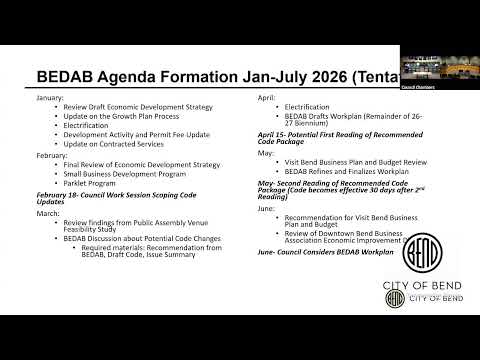
Presenters detailed the statutory process and timeline: if council gives direction on scope, rate and boundary in January, staff would manage owner notification and calculations, and the EID could be established by the start of the next fiscal year (July 1) following the required public hearings and remonstrance process. Presenters emphasized the EID is intended to complement — not replace — urban-renewal financing by providing maintenance funding for capital investments.
Next steps: BDAB members signaled support for drafting a letter of endorsement and asked staff and board volunteers to prepare language for council in January. The item will proceed to council consideration and, if advanced, will follow the city's notice and remonstrance schedule with at least two public hearings.