
Staff presents draft short‑term rental ordinance; commission gives mixed direction on limits, home shares and enforcement
Get AI-powered insights, summaries, and transcripts
Subscribe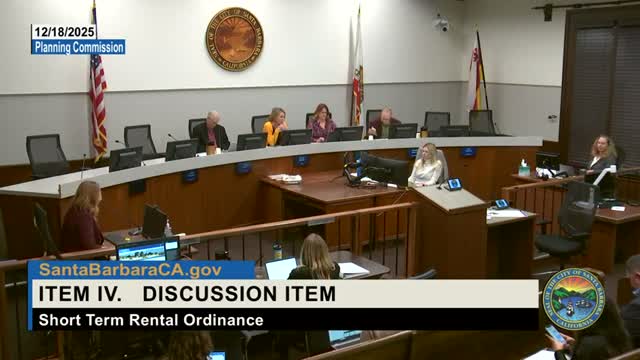
Summary
Planning staff presented a draft short‑term rental ordinance that would prohibit whole‑home STRs in single‑ and two‑unit zones, create a coastal licensing area and require permits for many STR uses; commissioners provided preliminary direction on permit paths, caps, parking and enforcement and asked staff to return with a full ordinance in February 2026.
Planning staff on Dec. 18 presented a draft framework for a citywide short‑term rental ordinance and asked the Planning Commission for policy direction on five core questions: the inland (Title 30) permit path, the coastal (Title 28) permit path and licensing area, limits on the number of licenses per owner, the grace period for existing operators, and parking standards.
Laura Bridal, project planner, said the draft aims to protect long‑term housing while providing lower‑cost visitor options through licensed home‑share programs and tightly regulated whole‑home permits in certain commercial or license areas. The proposal would generally prohibit whole‑home STRs in single‑ and two‑unit residential zones, allow home shares where the primary resident is present, and designate a coastal license area where CUP‑based permits could be issued for STRs; staff emphasized the work must be negotiated with the California Coastal Commission and that coastal approval typically lengthens the timeline.
Staff laid out three policy tiers for each question (more restrictive / moderate / less restrictive) and requested the commission’s feedback. Key features explained by staff and discussed by commissioners included:
- Permit path and appeals: staff proposed a discretionary Conditional Use Permit (CUP) route in many cases because the city lacks an intermediate, appealable ministerial permit; several commissioners asked staff to explore a mid‑level permit (a ministerial but appealable pathway) as an alternative to a full CUP to reduce staff burden while preserving public appeal rights.
- Home shares: the draft allowed home shares (primary resident present) broadly in residential zones; commissioners were split. Several members asked that home shares be limited to the same zones where whole‑home STRs would be permitted (so the two programs mirror each other). One commissioner recommended removing home shares entirely because of enforcement concerns.
- Number of licenses: staff proposed limiting licenses to one per owner (conservative approach). Commissioners generally supported a stricter approach (one license per owner) to limit investor portfolios; some suggested allowing flexibility in coastal license areas.
- Grace period and enforcement: staff proposed a six‑month grace period for operators to apply under the new rules. Commissioners asked for robust, proactive outreach to operators (finance data on existing TOT filers, platform notifications) and for the ordinance to include stronger enforcement tools (higher administrative penalties now permitted by state law, platform data‑sharing and possible platform liability clauses) so that unpermitted listings can be quickly identified and removed.
- Parking and neighborhood caps: staff proposed mirroring existing zoning parking metrics (e.g., two spaces for up to four bedrooms, three spaces for five or more) but asked whether certain high‑impact streets or coastal access areas should have stricter parking review or neighborhood caps. Commissioners suggested transportation staff develop a map‑based approach to identify streets with limited parking or higher safety concerns; some asked staff to study neighborhood saturation caps (a limited number of licenses per block or census tract) and report feasibility.
Public comment showed a sharp split: neighborhood groups urged strict limits or bans to protect livability, local housing supply, and noise compatibility; operators, property managers and the tourism sector urged less restrictive rules, argued that many owners use STR revenue to keep homes, and warned that prohibitions would reduce TOT revenue and local jobs. Many written submissions asked for strong enforcement mechanisms and data‑sharing with booking platforms.
Commission direction and next steps: commissioners gave staff detailed policy feedback and asked staff to return to the commission on Feb. 19, 2026 with a full draft ordinance including: analysis of historic structures and how many downtown parcels would be eligible, alternatives to full CUPs (a mid‑level appealable ministerial pathway), clearer maps of license areas and parking‑impacted streets, predictive enforcement costs, and recommended penalty structures. Staff also said they will continue coordination with California Coastal Commission staff, and that Coastal review will likely add additional time to adoption.