Lifetime Citizen Portal Access — AI Briefings, Alerts & Unlimited Follows
Water commission defers Turtle Bay stream‑channel permit after questions about cultural review and scope
Loading...
Summary
The Commission on Water Resource Management deferred consideration of stream channel alteration permit SCAP 6438.3, citing requests for a fuller presentation from the new owner about cultural consultation, flood and sea‑level‑rise analysis, and how the culvert fits into the broader development. The applicant agreed to return with a consolidated slide package and community outreach plan.
The Commission on Water Resource Management on Nov. 18 deferred action on stream channel alteration permit application SCAP 6438.3, the resubmittal for a precast bridge/culvert crossing associated with development on Lots 13–15 at Turtle Bay.
Dean Ueno, presenting for the commission’s Stream Protection and Management Branch, summarized the submittal as a resubmittal of an expired permit originally issued in May 2022 and described attachments including the 2013 final supplemental environmental impact statement, a 2012 cultural impact assessment (CIA) and technical appendices. Ueno said agency comments from the Department of Planning and Permitting, Division of Aquatic Resources and the State Historic Preservation Division had been addressed in the current package and that staff recommended approval with conditions including incorporation of U.S. Fish and Wildlife comments and DHHL‑related conditions.
The applicant team — represented by consultant Harley Myers of Wilson Okamoto Corporation and landowner/representative Darren Flanagan — told commissioners they have continued consultation with lineal descendants and qualified archaeologists and that the project design remains consistent with previously approved permits. ‘‘We’ve completed site tours, consulted with neighborhood boards and maintained contact with stakeholders,’’ Flanagan said in response to questions about the dissolved hotel advisory committee.
Commissioners focused intensive questioning on two areas: whether the existing cultural review (Kapaʻakai framework and the CIA) remains adequate given the change in ownership and whether the permit package gives enough context about the culvert’s role in an overall development that includes access and phased construction. Commissioner concerns included specifics about which traditional and customary practices are found in the project area, whether the cultural consultation log documents continued engagement with lineal descendants, and whether flood‑risk and sea‑level‑rise modeling reflects the latest guidance.
Consultants Jake Usman (River Focus) and Ian Hardy (Sea Engineering) described recent hydraulic and two‑dimensional flood modeling, including combined scenarios (hundred‑year flood plus high‑tide and sea‑level‑rise scenarios), and offered to show detailed exhibits. ‘‘We modeled worst‑case combined scenarios and found minimal upstream increase because the downstream berm and culvert capacities control hydraulics,’’ Jake Usman said.
Several commissioners said the packet felt piecemeal and requested a single, coherent presentation from the new owner explaining what — if anything — has changed since the 2013 FSEIS, how many units are now proposed compared with prior approvals, and how the culvert functions as part of the development’s access network. Chair Dawn Chang said commissioners must be able to ‘‘meet our constitutional obligation under Article 12, Section 7’’ to confirm the protection of traditional and customary practices before concluding agency review.
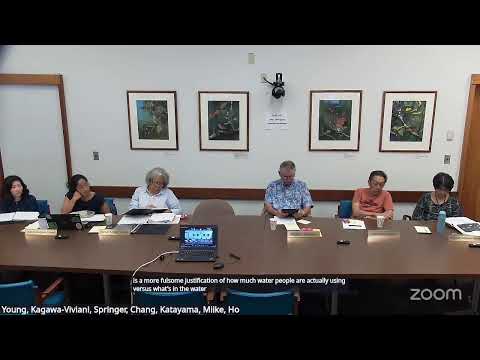
The commission made a motion to defer B1, which was seconded and approved at the meeting. The chair asked the applicant to return with a consolidated slide presentation addressing the community comments, provide clearer documentation of ongoing consultation with lineal descendants and clarify flood and cultural analyses.
The commission thanked the applicant for agreeing to produce a more succinct package and scheduled follow‑up consideration pending that supplemental submission.
What’s next: The applicant agreed to return with an expanded presentation and documentary support; commissioners said staff will engage with the applicant and community stakeholders to set the next date for B1 to return to the commission.