
Atherton council approves first reading to adopt 2025 state building codes; fire officials clarify sprinkler, ADU rules
Get AI-powered insights, summaries, and transcripts
Subscribe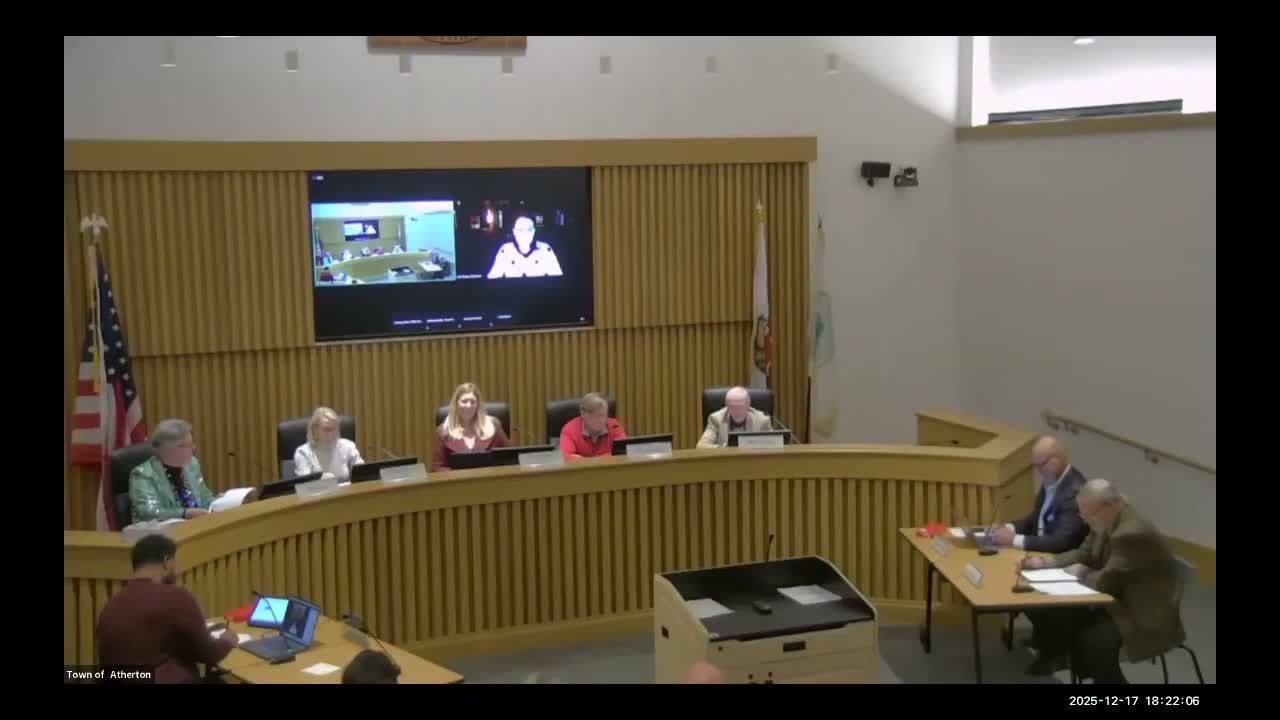
Summary
Council gave first reading to a proposed ordinance adopting the 2025 state building codes and heard technical clarifications from the town building official and the Menlo Park fire marshal on lithium battery provisions, ADU exemptions and sprinkler thresholds.
At a public hearing on Dec. 17 the Atherton Town Council introduced, by title, an ordinance to adopt the 2025 state building codes and amend Town Municipal Code Title 15. Fred Lustenberger, the town’s building official, said the triannual code update is largely unchanged this cycle and becomes effective statewide on Jan. 1.
Council members asked whether new language on lithium batteries (cited in code sections 703.2.10.3 and 905.3.11 in the proposed amendments) would require sprinkler systems in existing buildings, ADUs or properties that add battery backups. Lustenberger and Gage Slice, fire marshal for Menlo Park Fire Protection District and the author of the referenced language, said the code language primarily applies to S-2 occupancy groups (commercial parking garages and parking structures associated with larger buildings), not typical residential settings.
Slice explained that most ADUs are exempt from sprinkler requirements under the state guidance and a 2023 bulletin from the state fire marshal, with a few caveats where water availability or specific basement occupancies are concerned. He added that while water does not immediately extinguish lithium-ion battery fires, sprinkler systems are designed to control surrounding combustible materials (Class A and B) and prevent fires from spreading car-to-car or structure-to-structure; where lithium hazards exist the code calls for a fire protection engineer to design appropriate systems.
Council member Elizabeth moved to approve the ordinance’s first reading; Council member Bill seconded. Because the item was a public hearing and an ordinance, the council conducted a roll-call vote. The clerk recorded an affirmative vote from each member present and the first reading passed.
What’s next: The ordinance passed its first reading; the council will carry the item forward in the ordinance process per standard municipal procedure (second reading/possible adoption at a subsequent meeting).