
Minnetonka council adopts 2026 budget and tax levy, sets utility rate changes
Get AI-powered insights, summaries, and transcripts
Subscribe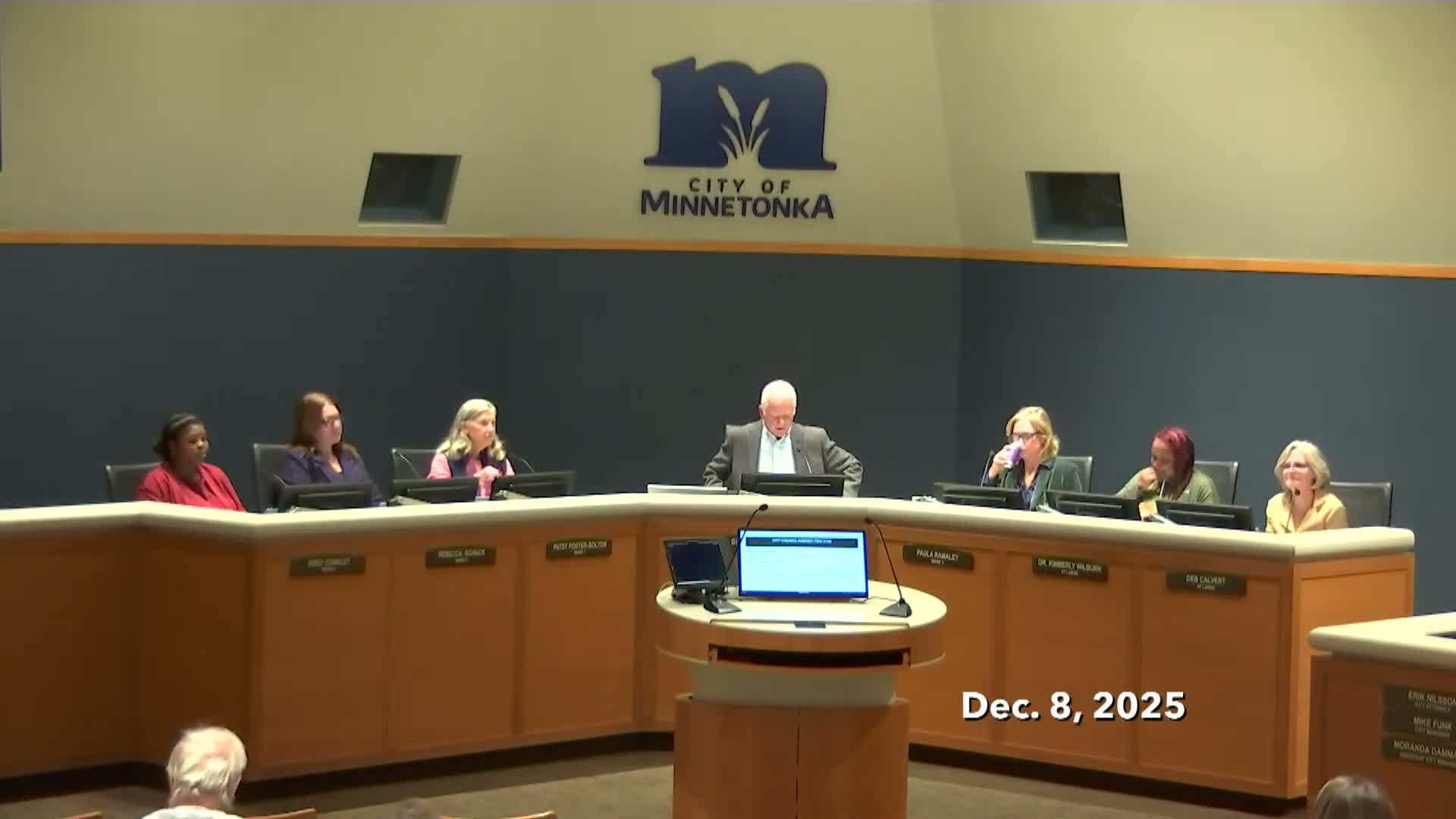
Summary
The Minnetonka City Council adopted its 2026 operating budget and the related tax levy after public comment and prolonged debate, approving utility rate increases aimed at funding long‑term infrastructure and a multi‑year public safety plan.
The Minnetonka City Council adopted the 2026 budget and set the property tax levy at the preliminary level discussed during the truth‑in‑taxation hearing, voting unanimously after public comment. The package includes a roughly 7.9% levy (preliminary 7.91% discussed at the hearing) and utility rate changes staff said are needed to fund aging infrastructure and a public safety master plan.
City Manager Mike Funk and Finance staff outlined the drivers of the increase: wage and benefit pressures, health insurance cost growth, a new Minnesota Paid Family Medical Leave cost, and the city’s multi‑year public safety investment to add firefighters, equipment and records management systems. Funk said the city’s asset‑management analysis shows a large concentration of water and sewer assets installed in the 1970s that will require replacement in the 2040s and beyond. “We know we’re going to have to address this and make sure that we maintain this asset of the city,” Funk said during the presentation.
Staff proposed changes to utility billing that take effect with bills issued in January 2026, including splitting the infrastructure line into dedicated water and sewer infrastructure charges ($63 per quarter for water, $31.50 per quarter for sewer), a restructured three‑tier water rate with the highest tier aimed at irrigation users ($7.50 per 1,000 gallons for the top tier), a roughly 3% stormwater fee increase, and a move to align recycling charges with the Republic Services contract. The council also set a slightly lower deferred‑charge interest rate for connection deferrals to reflect municipal bond yields.
Council members repeatedly framed the increases as a choice between incremental, planned investment to preserve service and the risk of crisis repairs or special assessments later. Council member Romilly said the council favored preventative spending: “I’d rather pay a penny now than a pound of flesh later,” she said, arguing steady investment reduces the chance of catastrophic failures and large, retroactive bills to homeowners.
Residents urged caution. Gwen Toliver, a resident since 1980, said her property taxes rose 14.8% this year after reclassification of improvements and called for deeper spending scrutiny, saying the city should prioritize “must haves” and cut “nice to haves.” Staff and councilors pointed listeners to state property tax rebate and refund programs and to ongoing opportunities for public input during the budget season.
The vote to adopt the 2026 budget, associated resolutions setting property tax levies for the city and special levies for entities such as the Housing and Redevelopment Authority, and non‑union wage recommendations passed unanimously on roll call.