Get Full Government Meeting Transcripts, Videos, & Alerts Forever!
Get email alerts on the Criminal Justice topic
No spam. Unsubscribe anytime.
Criminal Justice Coordinating Council warns deep City‑Parish cut would force staff losses
Summary
The Criminal Justice Coordinating Council told the Metropolitan Council that a proposed FY2026 City‑Parish allocation of $125,000 — a 54.4% reduction from supplemental funding cited for 2025 — would imperil core staff and operations; CJCC leaders emphasized opioid‑abatement funds are restricted and do not replace operational support.
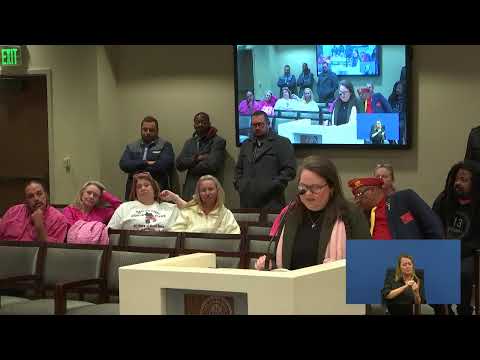
Chris Onka, executive director of the Criminal Justice Coordinating Council, told the Metropolitan Council at the fourth and final FY2026 budget hearing that the council’s proposed allocation for CJCC would drastically reduce the agency’s ability to pay core staff and run day‑to‑day operations.
“The proposed budget of 125,000 represents a 54.4% reduction from the ’25 budget,” Onka said, adding that the $260,000 in opioid abatement funding cited elsewhere is restricted to specific programs and cannot cover core staff salaries or operating costs. He said CJCC has eight employees, five funded through program grants and three “core” staff (executive director, deputy director, project assistant) who depend on City‑Parish operational support.
Onka outlined CJCC programs that he said produce measurable results: a pretrial diversion and recovery program (seeded by the MacArthur Foundation), a retail‑theft diversion court (45 identified participants and 19 graduates in the program’s first year), jail‑based case navigators who have connected roughly 3,000 newly arrested people to services, and a Capital Area Prisoner Reentry Initiative that unites more than 250 coalition members and community providers. He also noted CJCC‑led monthly public hearings and a statewide public safety summit aimed at aligning legislation and local practice.
Onka told councilmembers CJCC has leveraged City‑Parish seed funding to attract roughly $4 in outside funds for every $1 in local support. He said reducing core support would force layoffs that could undermine pretrial services, case processing and re‑entry supports that he argued help keep the parish’s jail population lower than it otherwise would be. Onka cited parish jail counts over time — “over 2,000” in 2017, a low near 1,100 in 2020 and an average of about 1,500 most recently — as context for the council’s investments in diversion and case processing.
Councilmembers asked whether smaller, parity‑style cuts (roughly 10–12%) could be absorbed; Onka said those reductions would buy time for fundraising but that the scale of the proposed cut would threaten the organization’s ability to maintain payroll and critical operations. Several council members and a mayoral representative pledged to meet with agencies and explore amendments, while noting overall budget constraints across the City‑Parish.
The council did not take a vote on CJCC funding at the hearing; the administration said it would continue discussions with councilmembers on amendments in the coming days.