
Police outline expanded cameras, drones and retooled bike patrols for downtown Laredo
Get AI-powered insights, summaries, and transcripts
Subscribe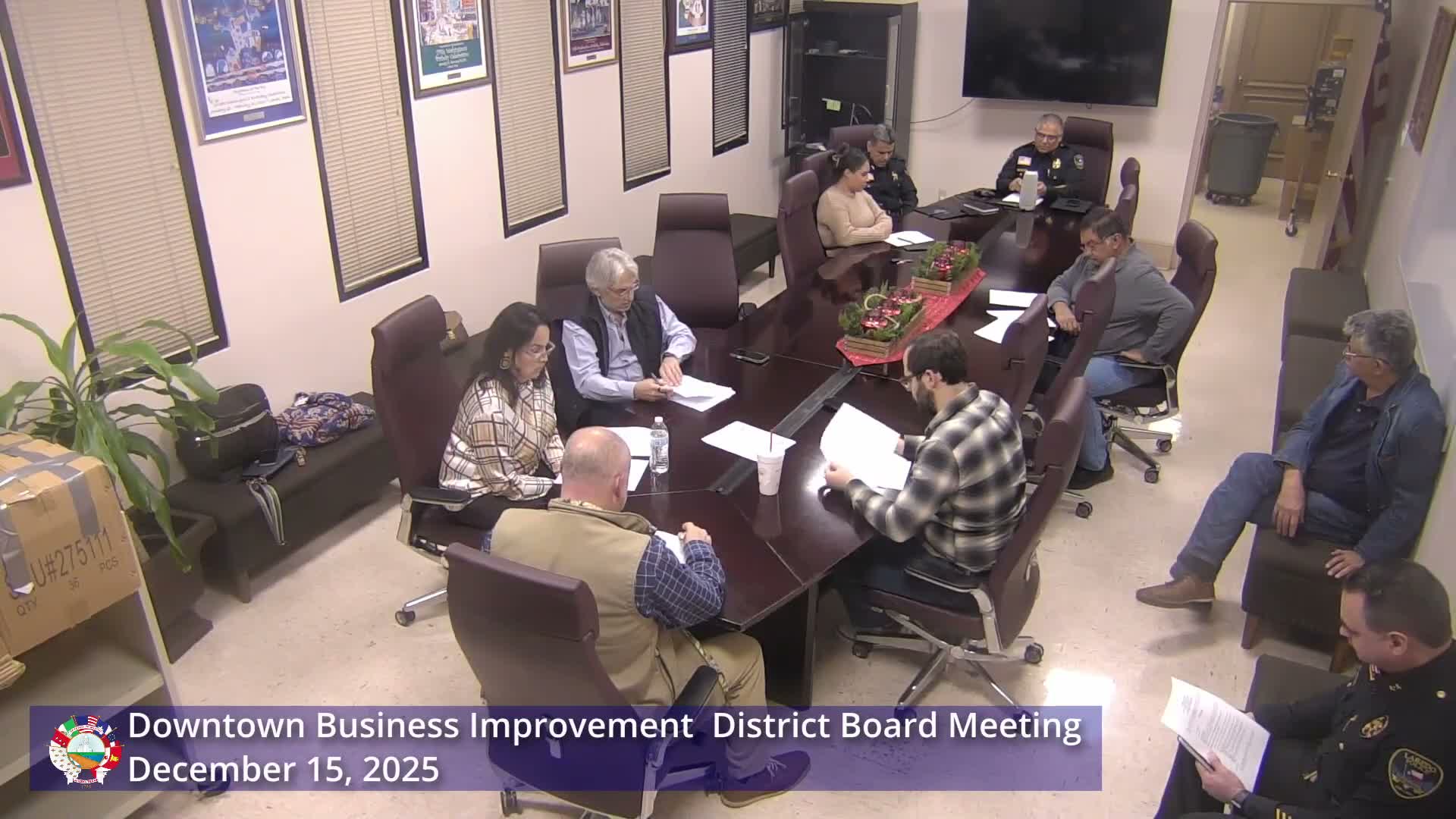
Summary
Assistant Chief Ricardo Gonzales told the Downtown Laredo BID the department has expanded cameras feeding a real‑time crime center, added license-plate readers and a drone program, and reintroduced motorized bike patrols to allow flexible, strategic deployments; the board discussed parking automation, maintenance waivers and ways to coordinate private cameras with police.
Assistant Chief Ricardo Gonzales told the Downtown Laredo Business Improvement District at its Dec. 15 meeting that the police department has expanded surveillance and response tools for the city’s downtown.
Gonzales said cameras now feed a real‑time crime center that civilians monitor and that the city has added license‑plate readers and a drone program to get to scenes “even before an officer is able to get dispatch.” He described a retooled bike patrol using motorized bicycles and said patrols have moved from fixed beats to strategic deployments, enabling supervisors to surge up to 10 officers where activity warrants.
“Cameras, not only do they serve as a deterrent, they help us solve [crimes],” Gonzales said. “We have them expanded outside of the area around to read it.” He added that the department now augments patrol with a drone program for rapid information gathering.
Board members raised recent break‑ins and vehicle burglaries at specific downtown addresses. Gonzales said the department’s internal statistics have not shown a spike in downtown vehicle burglaries but acknowledged underreporting is possible and pledged to check incident histories for locations cited by property owners.
The board and police also discussed parking enforcement and meter technology. Gonzales said automating meters and allowing credit‑card and phone payments would make enforcement and temporary waivers easier to manage. He proposed that plate‑based waivers could simplify short‑term maintenance work downtown so service trucks are not ticketed.
Gonzales outlined a single point of contact model: a strategic community commander (a lieutenant) assigned to each council district to act as a work‑order coordinator between the department and community groups. He said the department can perform lighting studies and walk‑throughs and will make a liaison available to the BID to facilitate faster follow‑up between monthly meetings.
On behavioral health, Gonzales said the department is piloting interventions and a trial diversion program for people committing low‑level offenses who also have substance‑use or mental‑health needs, aiming in some cases for civil commitment and treatment rather than jail.
The BID thanked police for the presentation and asked to formalize a subcommittee or point of contact to maintain an ongoing feedback loop. The department offered to assign a liaison who can report back on complaints, scheduling and resource deployment.
The meeting closed with board members noting that direct services such as lighting and security will be a priority in the BID budget and that supplemental private security and coordinated camera access may be used to increase daytime and nighttime activity downtown.