
Portland adopts 2026 state and federal legislative agendas; council asks for briefings on LC 5 inclusionary zoning
Get AI-powered insights, summaries, and transcripts
Subscribe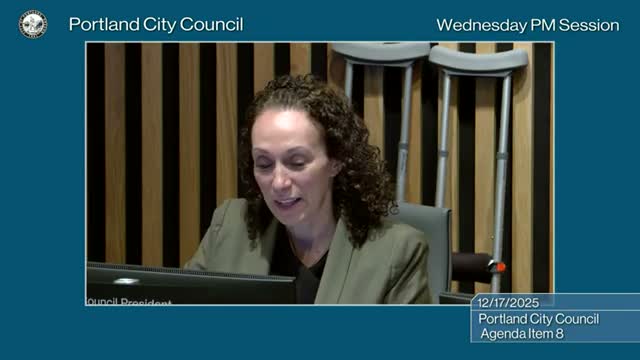
Summary
The council approved a coordinated state and federal legislative agenda and operating best practices as a living document, while public testimony and councilors prompted further analysis of a proposed state inclusionary zoning concept (LC 5) and behavioral‑health language.
Portland City Council voted unanimously to adopt the 2026 state and federal legislative agendas and a set of operating best practices for intergovernmental relations, telling the Office of Government Relations (OGR) to use the document as a guide for the upcoming short legislative session.
Council President framed the document as a living framework to protect the city's local authority, pursue revenue opportunities, and defend key resources in a politically and fiscally constrained session. "These practices don't alter any legal or charter authority," the council president said, calling the package a tool for coordination with state and federal partners.
Public testimony included a call from State Senator Khan Pham to consider a legislative concept (LC 5) intended to provide funding guardrails for inclusionary zoning programs. Senator Pham described LC 5 as providing flexibility without mandating additional action by Portland. OGR staff and city attorneys, however, flagged potential problems: they said LC 5 could create an unfunded mandate, introduce legal liabilities and shift funding decisions from local councils to the state unless modified.
Several councilors asked for the legislative concept language and legal memos to be circulated and for additional briefings. Councilors acknowledged the city's short‑session constraints and signaled willingness to work with state partners but requested clearer criteria for when the city takes proactive positions versus defensive ones. Councilor Smith asked OGR to identify top three priorities for the short session and to engage council where district‑level impacts arise.
The council adopted the resolution by roll call (12–0) and asked OGR to continue engagement with Senator Pham's office, the housing bureau and the law department to resolve concerns. Councilors also requested better wording around behavioral‑health capacity so the agenda reflects a stronger commitment to expanding treatment access.
What’s next: OGR will circulate the LC 5 legislative concept language, legal analysis and staff recommendations; council members asked to be available for briefings during the abbreviated session and to provide community engagement as needed.