
Portland governance committee advances ordinance tightening oversight and transparency for appointed boards and commissions
Get AI-powered insights, summaries, and transcripts
Subscribe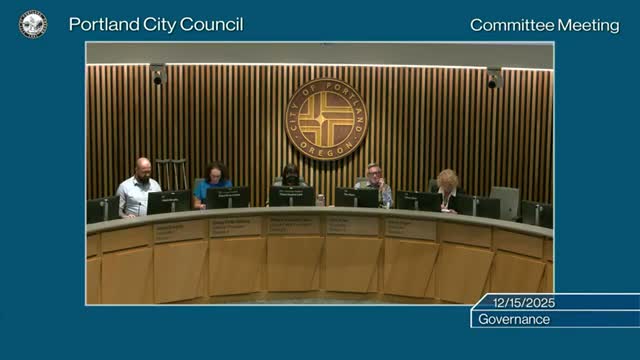
Summary
The Governance Committee sent an ordinance amending city code on appointed boards, commissions and committees to full council with a due-pass recommendation after debating seven sponsor amendments. Law staff and councilors disagreed over reporting requirements and administrative-rule language; several amendments passed, others failed or were returned for revision.
The Portland City Council Governance Committee voted to send an ordinance that revises code governing appointed boards, commissions and committees to the full council with a due-pass recommendation after a daylong review and debate.
The committee met Monday to continue work on an ordinance intended to clarify definitions, membership reporting and the relationship between city code and administrative rules. Councilor Dunfee, sponsor of a set of seven amendments, said the changes aim to make code “as straightforward to a plain reading” as possible and to improve public access to information about advisory bodies. Dunfee moved several amendments, arguing the changes protect the council’s decision-making role and increase transparency.
Why it matters: supporters said the changes address a longstanding problem tracking the city’s many advisory bodies, while critics warned the new language could intrude on mayoral executive authority or create operational burdens. Staff and the city attorney recommended edits to preserve charter limits while improving public notice and reporting.
Key outcomes and details: Dunfee’s stylistic package (Dunfee 1, 3 and 7) passed on a 5-0 roll call after staff and the city attorney described them as mainly housekeeping changes. A separate reporting amendment originally filed by Dunfee (Dunfee 5) — which would have required the city administrator to report certain details about mayor-created advisory bodies within 30 days — failed on its initial vote after a lengthy debate over timing and scope. Committee members later negotiated revised language that required membership and key information to be posted where ABC information is publicly available; that amended proposal was approved.
The committee divided a second package into two votes. Dunfee 2 (technical and clarifying edits including a new classification for "council-delegated decision-making bodies") passed after friendly edits. Dunfee 4, which contained additional structural changes, failed. Dunfee 6 (HR-related language) was referred back to the sponsor’s office after concerns were raised about removing the Bureau of Human Resources by name; staff and council members said the HR provisions need more work to preserve employee-protection mechanisms.
City attorney and staff input: Deputy City Attorney Sarah Ames told the committee there were no legal concerns with some of the sponsor’s amendments and recommended concise, alternate language in places where the charter constrains council action. On reporting, staff emphasized that while the council can request after-the-fact reports about mayor-created bodies, it cannot preempt the mayor’s charter authority to create advisory bodies by executive action.
Council reactions: Vice Chair Ryan repeatedly expressed concern about last-minute amendments and said he wanted more time to review documents before voting. Council President said she supported transparency but suggested moving some membership disclosure language into administrative rules or a public website to avoid overburdening the ordinance.
Votes at a glance: - Dunfee 1, 3 and 7 (stylistic package): passed (5-0). - Dunfee 5 (original reporting requirement): initially failed (recorded as failing at roll call). - Revised Dunfee 5 (membership posting and reporting tweaks): approved (3 ayes, 1 no, 1 absent on amended language). - Dunfee 2 (technical edits, classification language with friendly amendment to "council-delegated decision making body"): passed (5-0). - Dunfee 4: failed on roll call. - Dunfee 6: referred back to sponsor for further work. - Underlying ordinance (document number noted in the record): advanced to full council with a due-pass recommendation as amended (3 ayes, 1 nay, 1 absent).
What’s next: The ordinance (document number cited in the committee record) will go to the full City Council with the committee’s recommendation to adopt the code updates and with the package of amendments that passed. Dunfee 6 will return to the sponsor’s office for further drafting and BHR-related discussion.
Representative quotes from the meeting: Councilor Dunfee said the code edits are necessary “to make the information as straightforward to a plain reading as possible.” Deputy City Attorney Sarah Ames advised the committee that the proposed reporting language should account for charter limits: staff can seek after-the-fact reports when the mayor uses executive authority. Vice Chair Ryan cautioned about late changes, saying that when he is "in doubt, [he] vote[s] no" if he has not had time to review new material.
The committee’s action reflects a balance between expanding public transparency about advisory bodies and preserving the charter’s allocation of executive authority; several details (notably the HR and administrative rules provisions) will be refined before final council action.