
El Paso commission approves two‑story infill at 118 Rio Grande after design revisions
Get AI-powered insights, summaries, and transcripts
Subscribe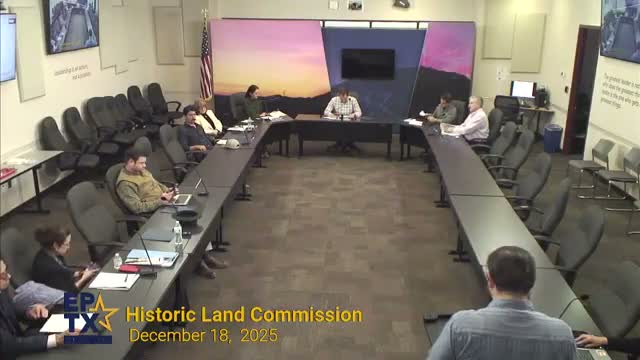
Summary
An El Paso commission approved a certificate of appropriateness for a two‑story building at 118 Rio Grande Avenue in Sunset Heights after the applicant removed a turret, simplified decorative detailing and squared the porch to avoid creating a ‘false sense of history.’
A city commission in El Paso on Dec. 20 approved a certificate of appropriateness for a two‑story infill at 118 Rio Grande Avenue in the Sunset Heights neighborhood, accepting staff's recommendation after the applicant revised architectural features flagged by commissioners.
Staff introduced the item as an application for a certificate of appropriateness for a two‑story building on a vacant lot at 118 Rio Grande Avenue in Sunset Heights, zoned SDHC (special development historic with conditions). Staff said the project's initial submittal, filed Sept. 18, included a turret and ornamental detailing that commissioners had described as creating a “false sense of history,” and that the applicant withdrew following an Oct. 16 hearing before resubmitting a simplified design.
“We're recommending approval based on the following, from the design guidelines for El Paso's historic districts,” a staff member told the commission, citing the commission's design guidelines and the Secretary of the Interior standards for rehabilitation and emphasizing that new construction should be compatible without appearing historic.
John Gutierrez, project manager for GE Architecture, told the commission the team had implemented the requested changes: “We took the committee's recommendations on a previous submittal … to square off the porch from being round to a little more octagon square looking porch. On the top, we added that parapet … The columns were reduced in size and thickness. We reduced the chimney so it wouldn't be so prominent. We removed … the cookie cutter detailing, removed the shutters away from the windows.”
Commission discussion focused on preservation principles: one commissioner asked whether staff generally opposed new structures that look historic, and staff replied that “it's generally good practice in historic preservation to not create a false sense of history.” The commissioner said that view seemed at odds with their prior experience; staff framed the policy as a guideline to keep new work architecturally compatible without conjectural historic features.
After the applicant's presentation, an unnamed commissioner moved to accept staff's recommendation for approval and the project's representative seconded. Commissioners voted in favor; the chair declared the motion passed and the building approved.
The meeting also approved the consent agenda, including meeting minutes (one member abstained because they were not present at the earlier meeting), and then adjourned.
What happens next: the commission approved the certificate of appropriateness for the resubmitted design; the transcript does not specify permit issuance timelines or other administrative steps required before construction begins.