
Flagstaff fire leaders outline $43 million capital ask and large ongoing staffing shortfall tied to 2029–30 timeline
Get AI-powered insights, summaries, and transcripts
Subscribe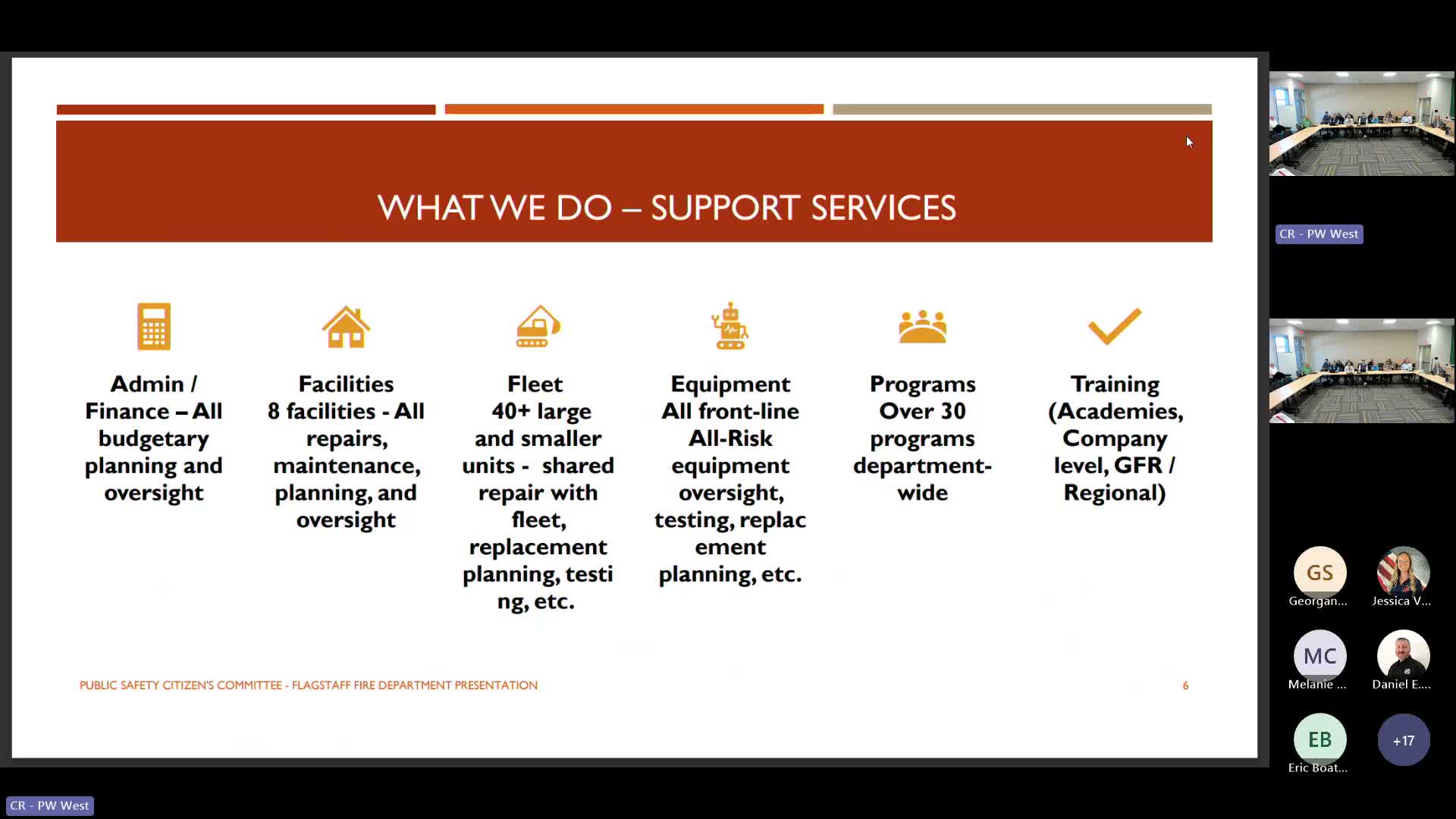
Summary
Fire department leaders told city officials that growth and rising call volumes have left Flagstaff understaffed and under-equipped, proposing $43 million in one-time capital and an ongoing staffing increase (presenters cited $16M–$18M estimates) to meet NFPA-informed response benchmarks.
Deputy department leaders told city officials that Flagstaff’s fire service is stretched ‘‘to the max’’ and cannot meet modern benchmarks for response and staffing without new funding. The presentation laid out a combined plan that officials said would require $43,000,000 in one-time capital and a multi-million-dollar ongoing increase in staffing and operations to reach standards of cover.
The briefing framed three core gaps — personnel and staffing, capital and equipment, and baseline operations — and tied them to population growth and changing building types. ‘‘The general fund is not able to keep up with current costs of our ability to do business and the demands of the community,’’ said the Deputy Chief responsible for Support Services during the presentation. The department said a standards-of-cover analysis indicates the need for roughly 75 additional full-time firefighters (25 per shift) to meet recommended daily staffing levels.
Deputy Chief (Support Services) provided line-item estimates: operational costs to staff 75 new FTEs were presented as $13,500,000 ongoing; an additional 11 administrative/support FTEs were estimated at $2,000,000 ongoing; and four community-risk FTEs at $750,000, producing ongoing funding estimates that presenters discussed in the $16.25 million to $18.25 million range depending on rounding and how items are grouped. The deputy chief said the department’s phased 10-year plan assumes full staffing would not be in place until about 2029–30 because facilities and staggered hiring are required.
On capital, presenters said new station capacity is needed (Station 7 to serve the J. W. Powell area was singled out), as were apparatus and training facilities. The briefing listed a one-time capital estimate of about $19,500,000 for a station plus apparatus and a separate $18,000,000 bucket of other one-time capital needs; combined one-time costs were summarized as $43,000,000.
Presenters tied the funding ask to nationally recognized response benchmarks, noting the department currently cannot meet NFPA-based goals such as a four-minute arrival for a first engine and the recommended number of firefighters on scene for large structure incidents. ‘‘We want 4 firefighters there on each engine and we want the first engine or point to get there within 4 minutes,’’ a standards presenter said, while acknowledging that Flagstaff’s current day staffing (about 23 personnel on duty) is far below the 42 firefighters that would be required for a major high-rise incident.
Officials stressed operational consequences if gaps persist: high mandatory recall and overtime levels (presenters cited more than 250 recalls in 2024), attrition and burnout among paramedics, reduced preventive inspection capacity, and growing risk to response times because of overlapping incidents and localized delays (train crossings and traffic were given as examples). The deputy chief said the department has maximized internal efficiencies and that additional revenue sources would be required to close the described gaps.
Funding options were discussed in general terms — bonds, sales tax and other revenue mechanisms — with staff urging that each option carries tradeoffs. The deputy chief noted the financial plan includes escalation assumptions (pay raises, CPI) and that any community funding strategy would require a multi-year implementation plan.
The presentation closed with operational context and next steps: recruitment remains difficult (recent academies carried vacancies), the department will present additional detail on wildfire management at a February briefing, and staff will work with city finance to model funding approaches should elected leaders want to pursue a ballot measure.
The department’s one-time and ongoing figures are presented here as they were shared in the briefing; presenters used rounded, phased estimates and pointed to line-item spreadsheets for exact breakdowns. The council and staff will continue to discuss detailed funding options and schedules.