
Hartford residents debate proposed limits on numbers of dogs and cats at public hearing
Get AI-powered insights, summaries, and transcripts
Subscribe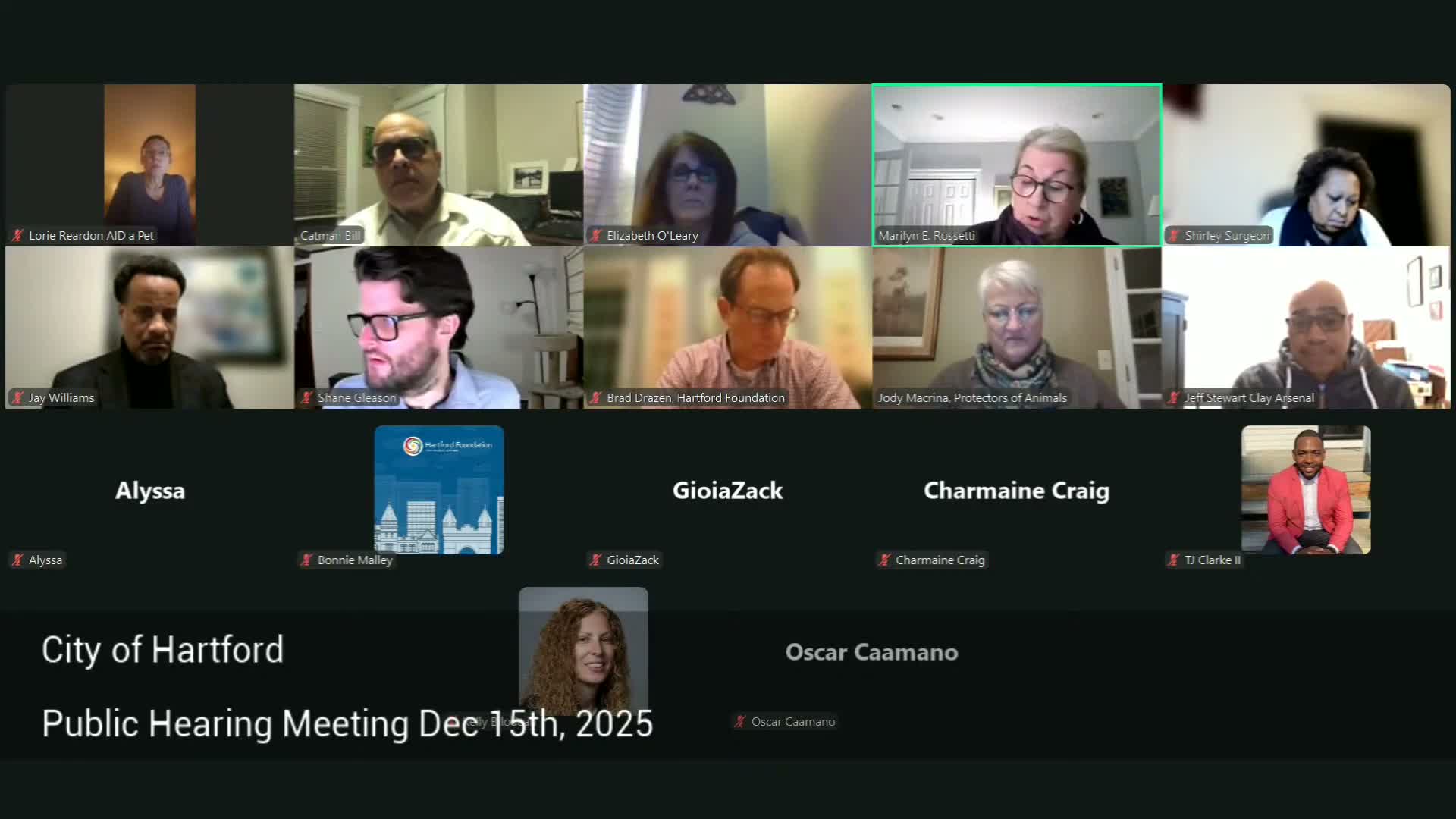
Summary
Residents, animal advocates and a planner offered competing views at a Dec. 15 public hearing over a proposed ordinance limiting numbers of dogs and cats; supporters said limits are needed to address persistent nuisance properties while opponents urged tabling, more services and investment in spay/neuter programs.
Hartford residents and advocates traded competing views Tuesday over a proposed ordinance that would limit the number of dogs and cats a household may keep.
Supporters told the Court of Common Council the measure would give animal-control officers a clear enforcement standard for recurring nuisance properties. "Right now, animal control tells us there's nothing they can do because there's no limit to the number of dogs who can live here," said Scott Campbell, a neighborhood resident and dog owner, who said repeated barking and distressed animals have diminished quality of life on his block.
Opponents — including local rescuers and a policy researcher — urged the council to table the proposal and study alternatives, arguing numeric limits are ineffective and risk harming low-income pet owners. "The overwhelming evidence in the literature is that ownership limits are ineffective at achieving their stated policy goals," said Shane Gleason of Protectors of Animals, a member of the organization's spay-trap-return team and a professor of public policy and law. Gleason and other speakers recommended investing in affordable spay-and-neuter programs, targeted cruelty statutes and education.
Jody Macrina, president of Protectors of Animals and the POA Spay Clinic, questioned the city's capacity to absorb animals if strict limits lead to surrender, and highlighted enforcement and affordability concerns: "How are you possibly going to collect a $100 fine per day when the affordability is not there?" she asked.
Other speakers described gaps in response capacity. Bill Katz recounted unsuccessful attempts to get animal-control assistance for a cat he tried to rescue, saying Hartford currently lacks dedicated feline services.
Francisco Gomes, a professional planner who testified in favor, framed the regulation as a municipal tool to protect neighborhoods and animal welfare and said it is within the city's authority to adopt such standards.
The council did not vote on the ordinance at the hearing. Rossetti called for additional speakers and, finding none, closed public testimony on item 2.3. The measure remains pending; supporters urged clearer enforcement authority while opponents called for stakeholder study and service investments before enactment.