
People's Economy Lab urges multi‑session community assemblies as a route to durable climate policy
Get AI-powered insights, summaries, and transcripts
Subscribe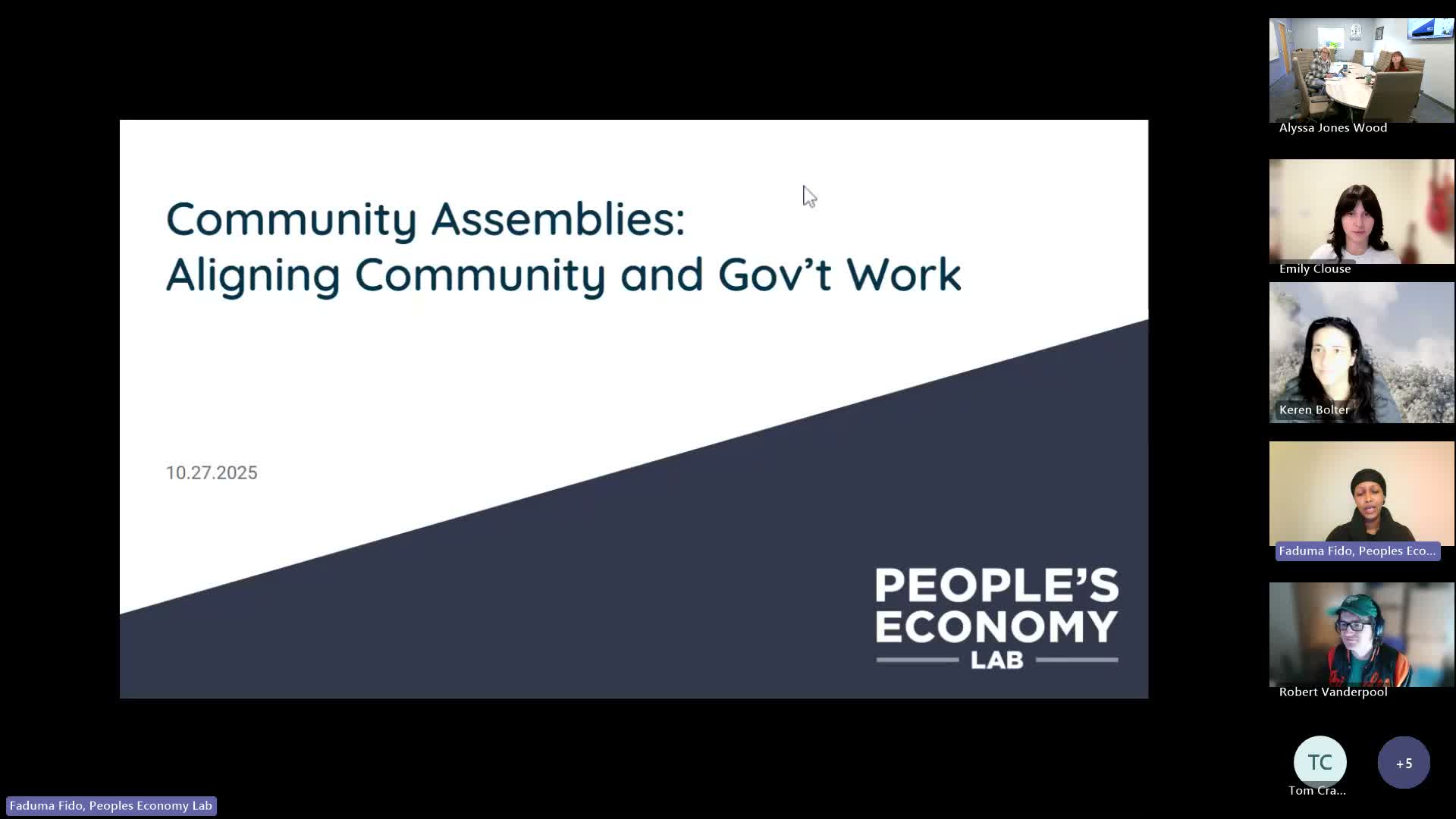
Summary
A lab leader from People's Economy Lab presented community assemblies as a deliberative, multi-session model to center residents’ voices in policy. Speakers and members raised funding and longevity questions and noted assemblies’ potential to turn lived-experience storytelling into policy outcomes.
A lab leader from People’s Economy Lab outlined how community assemblies can deepen local democracy and shape climate policy during the Oct. 27 Thurston Climate Mitigation Collaborative Executive Committee meeting.
Fadimofido, a lab leader with People’s Economy Lab, told the committee that community assemblies are “multi‑session, structured deliberation” designed to give residents time to learn about a topic, deliberate, align values and make co‑created recommendations to decision‑makers. “Governance without belonging doesn’t work,” Fadimofido said, adding that assemblies must include strong facilitation, breakout work, multi‑hour commitments and follow‑up reporting so outputs can become outcomes.
The presentation, which drew examples from Porto Alegre (Brazil), Jackson (Miss.), Belgium and Seattle, distinguished three assembly types: citizen assemblies (government‑initiated with sortition), movement assemblies (community‑initiated coalition building) and hybrid community assemblies (partnered with government but anchored by community organizations). Fadimofido described Seattle and other Washington projects as hybrids where government funds the process and community anchors run the work.
Committee members asked how assemblies are funded and sustained. Tom Crawford, a board member of the Thurston Climate Action Team, asked, “How does that longevity kind of get funded or how does it get supported over time?” Fadimofido said models vary: some long‑running efforts become formal instruments within government budgets; others rely on philanthropy, participation stipends or multi‑year commitments from state agencies. She noted that securing multi‑year funding and philanthropic partners is often required to carry assemblies from recommendations to implementation.
Several members, including Robert and Commissioner Clauss, praised the model’s capacity to generate ownership and lived‑experience stories that strengthen policy proposals but warned assemblies risk eroding trust if input is solicited and not used. Fadimofido urged planning for reporting and follow‑up—dashboards, community updates and workshops—to keep participants tethered to outcomes.
The committee’s discussion linked the assemblies presentation to ongoing TCAT and jurisdictional outreach: Paris McCluskey (Thurston Climate Action Team) said recent community assemblies in the county and Tumwater expanded participation, and Tom Crawford summarized a Cooling Thurston pilot that installed 51 portable heat pumps for low‑income tenants as an example of community‑focused action.
The meeting did not adopt any new policy on assemblies; members asked staff to circulate slides and resources and to consider assembly approaches when budgeting future community engagement. The committee moved on to its next agenda item after the presentation.