
Scotts Valley council certifies EIR and adopts 2025 Town Center Specific Plan allowing up to 657 housing units
Get AI-powered insights, summaries, and transcripts
Subscribe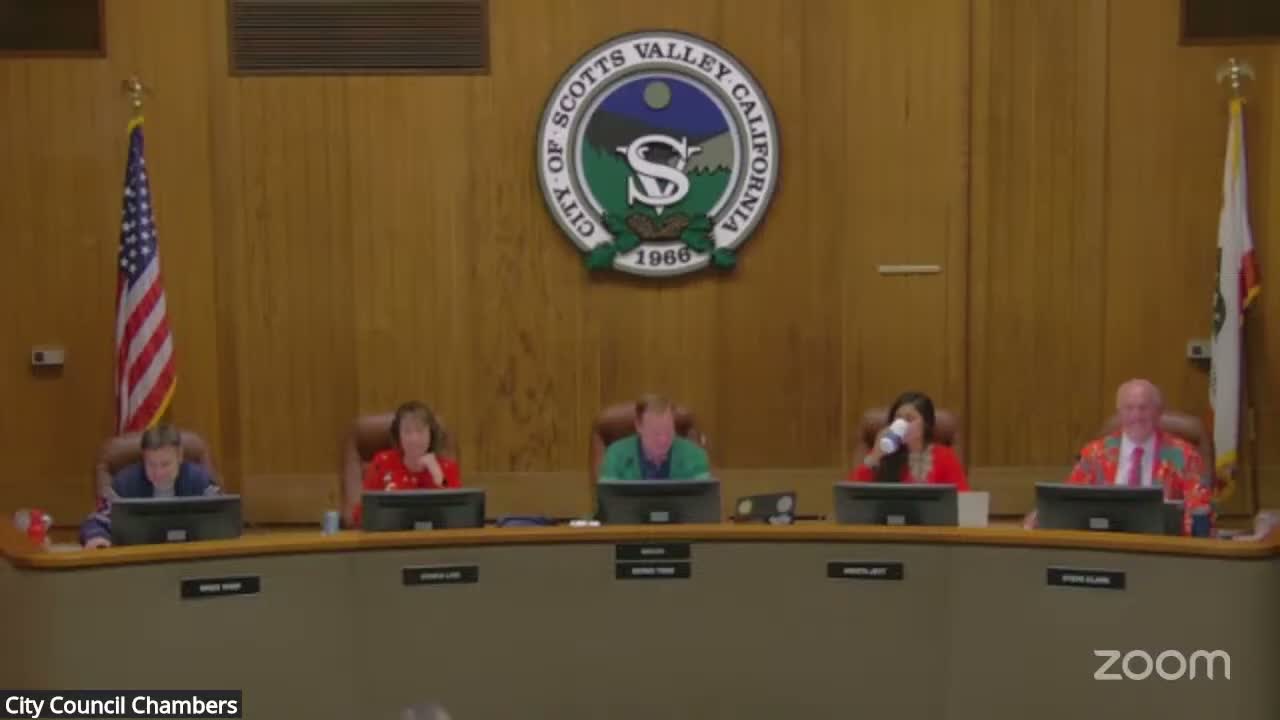
Summary
The Scotts Valley City Council unanimously certified the final environmental impact report and approved the 2025 Town Center Specific Plan, authorizing up to 657 housing units across roughly 60 acres and about 82,000 square feet of commercial space while adopting a statement of overriding considerations for two unavoidable environmental impacts.
Scotts Valley — The City Council on unanimous votes certified the final environmental impact report (EIR) and approved the 2025 Town Center Specific Plan on the evening's agenda, advancing a long‑planned effort to create a compact downtown with housing, retail and public plazas.
Troy Reinholter, lead consultant for the specific plan, told the council the effort "represents the culmination of several years of hard work by staff, our team, community, and decision makers." The plan would cover roughly 60 acres, including 12 acres purchased from the city of Santa Cruz that formerly made up Skypark Airport, and allow up to 657 housing units over a 20‑year build‑out, along with about 82,000 square feet of commercial uses and roughly 35,000 square feet of public or quasi‑public space.
The council also certified the final EIR and adopted a statement of overriding considerations for two impacts the report found could not be fully mitigated: long‑term greenhouse gas emissions and contribution to vehicle miles traveled. Oconee Danielson, who presented the EIR, said the findings reflect the limits of local control over statewide climate outcomes and the plan's projected long‑range travel effects.
Council members asked detailed questions about how the plan would be implemented and what would be decided at the project level. "Tonight we're setting the broader contours of the rules and regulations that a future development project has to abide by," Reinholter said, explaining that later steps — an RFP for the city‑controlled core, developer selection and a development agreement — will determine specifics such as final site layouts, exact parking counts and phasing.
The city will require a minimum of 300 housing units be developed within the city‑controlled core area to satisfy surplus lands actions; the remainder of the 657 units are anticipated across properties within the plan boundary over time. The plan anticipates more than two acres of new public plazas — including a Tower Point Plaza and a roughly quarter‑acre Hangar/Hanger Square with features such as a fountain or splash pad — and a network of new streets designed for pedestrians and cyclists (Main Street, Park Street, Theater Walk and Arrow Lane).
Traffic analysis in the EIR found most studied intersections would retain acceptable levels of service, but Kings Village Road at Mount Hermon Road could degrade from LOS C to LOS D during the evening peak under some build‑out scenarios. Reinholter and staff described mitigation options ranging from restriping and lengthening turn pockets to acquiring right‑of‑way to add a third southbound lane. The council was asked to allow the possibility of LOS D at that intersection while reserving final mitigation decisions for project‑level reviews and development‑agreement negotiations.
Parking emerged as a frequent public concern. The specific plan sets parking ratios by use (for example, consultant guidance cited roughly four spaces per 1,000 sq ft for general retail and higher ratios for restaurants) and calls for publicly accessible shared surface parking behind storefronts, time‑limited on‑street spaces and a developer‑submitted parking management plan. Consultants said the plan leans toward small‑format, experiential retail rather than one large anchor tenant.
During the public hearing, residents raised questions about financing and taxes, the scale of commercial space, and neighborhood impacts. Malika Thompson asked whether a special tax such as a Mello‑Roos might be used; City Manager Molly said the city does not intend to levy new resident taxes and is considering an Enhanced Infrastructure Financing District (EIFD) that would apply future property‑tax increment from development toward infrastructure rather than imposing immediate new taxes on current residents.
Daniel Alvarez, a field representative for the NorCal Carpenters Union, urged use of responsible contractors and apprenticeship programs during construction. Other speakers voiced support for family‑oriented amenities such as a splash pad and outdoor dining.
Council member Steve Clark moved to certify Resolution No. 2081 (final EIR and statement of overriding considerations) and then Council member Jett moved to adopt Resolution No. 2081.1 approving the Town Center Specific Plan; both motions passed unanimously. Mayor Tim declared the motions carried.
Next steps outlined by staff include returning to council next year with implementing amendments to the general plan and zoning ordinance and issuing an RFP for the city‑controlled core parcels. Project‑level reviews, development agreement negotiations and required mitigation monitoring will follow as developers come forward.
The council’s action advances a community vision the city says has been guided by multiple public outreach efforts and technical studies; it does not itself approve any individual project or construction timetable and reserves further approvals for future project‑level hearings.