
Mount Pleasant council adopts limits on frequent public‑information requests
Get AI-powered insights, summaries, and transcripts
Subscribe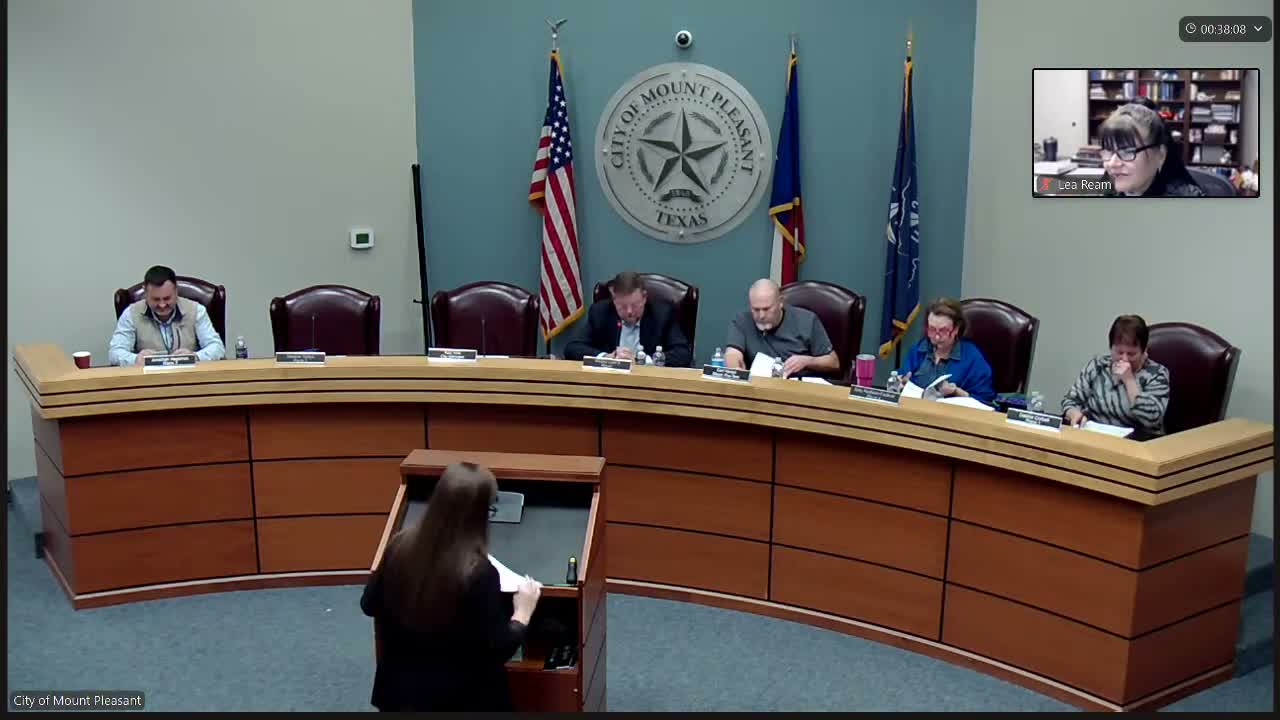
Summary
The Mount Pleasant City Council unanimously adopted ordinance 2025‑24 to allow recovery of administrative personnel time and limit "frequent requesters" when a single requester’s personnel time exceeds 36 hours per fiscal year or 15 hours per calendar month.
The Mount Pleasant City Council voted unanimously Tuesday to adopt ordinance 2025‑24, which allows the city to recover administrative personnel time for frequent public‑information requests and sets minimum thresholds before cost recovery applies.
City Attorney Hailey said the ordinance is aimed at requesters whose cumulative requests impose substantial staff time. "It only really impacts when you have somebody who is making requests of the degree that set forth where you have a requester that is submitting a request that costs more than 36 hours per fiscal year or 15 hours per calendar month," Hailey said, explaining the measure provides a means to recover administrative time when those limits are reached.
The ordinance does not change standard deadlines or other requester rights under the Texas Public Information Act, Hailey told the council; rather, it adds a process for frequent, high‑volume requesters to agree to estimated personnel costs before the city proceeds.
During public comment, local resident and federal whistleblower complainant Kyle Morring urged stronger transparency safeguards and an audit trail for timekeeping. "When access to records becomes expensive, delayed, or discretionary, the public is left wondering who the system is really protecting," Morring said, adding that if access remains restricted he will make his evidence public so residents can judge the facts themselves.
Council members asked staff how personnel time would be measured and whether the city would publish aggregate request counts and a formal policy implementing the ordinance. Assistant City Manager Webster said time would be tracked when staff actually spend it on a request and that requesters would receive a cost statement showing hours; staff also committed to draft written procedures to ensure consistent handling and to confer with requesters to narrow scopes where possible.
Councilman Hagan moved to adopt the ordinance; the motion was seconded and passed unanimously.
The ordinance takes effect per municipal rules; staff said they will return proposed written procedures and clarification language to ensure consistent application and to address media‑exemption standards and appeals procedures.