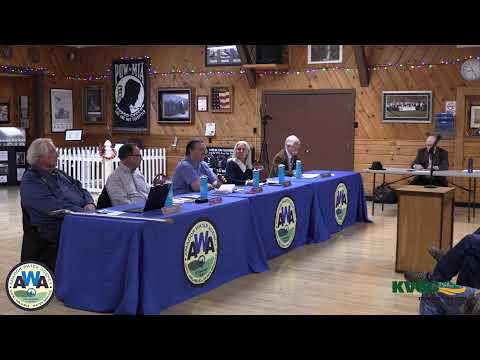
Amador Water Agency approves five‑year water and wastewater rate increases after public hearing
Loading...
Summary
After public hearings and insufficient protest counts, the Amador Water Agency Board of Directors voted 5–0 to adopt resolutions raising water and wastewater rates for fiscal years 2027–2031 to fund urgent treatment‑plant and storage projects and meet debt coverage requirements.
The Amador Water Agency Board of Directors voted unanimously to adopt two resolutions that increase water and wastewater rates for fiscal years 2027–2031 after presentations from agency staff and rate consultants and more than an hour of public comment.
Board President (name not provided) opened public hearings under Proposition 218 and heard presentations from General Manager Larry McKinney and consultants from Water Resources Economics about a five‑year financial plan the agency says is needed to address aging infrastructure and secure debt financing. "The Amador Water Agency ... provides water service wholesale and retail, treated and untreated to just a little under 25,000 people," McKinney said while framing the service area and the legal duty to recover costs through rates.
The rate study, the consultants said, models operating costs, capital‑improvement needs, reserve targets and debt coverage ratios. The agency’s most urgent list includes six debt‑funded water projects — a failing tank ("Tank D"), a clear‑well replacement at the Tanner Treatment Plant, operational upgrades to increase plant reliability, and backwash water handling — plus two prioritized projects at the Ione treatment plant to address bottlenecks and safety hazards. McKinney said the urgent package is currently estimated at about $50–$60 million, of which roughly $19 million has already been borrowed.
The consultants presented a plan that would limit some capital outlays to reduce near‑term customer impact and modeled reserve draws and new debt service. The first‑year water increase in the proposed plan was described as about 7%; consultants said part of that reflects inflation and part reflects debt coverage needs tied to projects that the agency judges cannot be deferred.
During public comment, residents and ratepayers questioned fairness and affordability, arguing the proposed increases shift too much cost to fixed monthly charges and reduce incentives to conserve. Talbot Hardy of Sutter Creek said, "It's getting to a point where the amount of water that we use is immaterial to our bill, and there's just no escape," arguing the fixed share of revenue reduces the conservation signal. Several commenters described high fixed bills for large‑meter or remote customers and urged the board to revisit meter classification and standby charges.
Sean Krilich of Jackson criticized a separate, pending agreement with Pacific Gas & Electric (PG&E) related to payments tied to the Amador transmission line and urged directors to oppose a consolidation he said would reduce payments AWA receives. The board did not debate the PG&E agreement at the meeting, saying it is agendized for the agency’s upcoming Thursday meeting and cannot be discussed tonight under Brown Act constraints.
Staff reported protest counts under Proposition 218: three valid protests against the wastewater proposal (well below the 418‑valid‑protest threshold to stop the measure) and 22 valid protests against the water proposal (the threshold to block the water rates was 3,736). With insufficient protests, the board moved to formal actions.
The board adopted Resolution No. 2025‑12, to adjust wastewater rates and charges for fiscal years 2027–2031, on a motion by Director Farrington with a second; the motion carried 5–0. The board then adopted Resolution No. 2025‑13, to adjust water rates and charges for the same period, on a motion by Director Parker and second by Director Deaver; that motion also passed 5–0.
The agency said the increases are intended to fund the most urgent reliability projects while the board continues to pursue grants and other non‑rate revenues. McKinney noted that federal and state grant funding is more limited than in prior decades and said the agency must use a mix of grants, pay‑as‑you‑go and debt to address vulnerabilities such as the deteriorated Tanner clear‑well and constrained Ione plant. He urged customers to report taste and odor incidents so staff can investigate local distribution issues.
The board thanked staff, consultants and the public, reminded residents of a Thursday meeting where the PG&E agreement will be discussed, and adjourned at 8:28 p.m. Actions taken at the meeting — the two adopted resolutions and the recorded protest tallies — are the formal outcomes of the Prop 218 hearings and will be reflected in the agency’s rates and billing schedules going forward.