Get Full Government Meeting Transcripts, Videos, & Alerts Forever!
Get email alerts on the School Finance Bonding topic
No spam. Unsubscribe anytime.
Piper Sandler presents 'Bonds 101'; consultant says district well under constitutional debt cap, could consider issue around 2027
Summary
A Piper Sandler consultant briefed the Kirkwood R‑VII board on general‑obligation bonds, lease purchases, levy management and methods of sale, saying the district is under Missouri's 15% constitutional capacity and that a no‑tax‑rate‑increase bond could be feasible in the 2027–2028 window; no decisions were made.
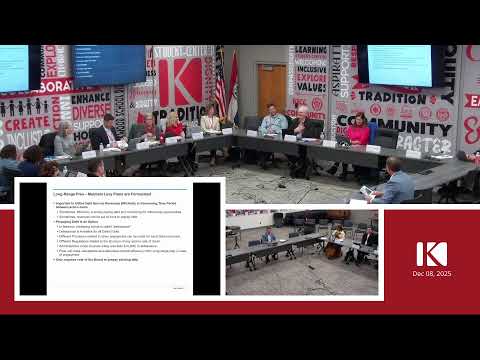
Brent Blevins of Piper Sandler gave a detailed informational briefing to the Kirkwood R‑VII School Board on how general‑obligation bonds and lease purchases work, what drives investor interest, and how districts structure long‑range financing.
Blevins explained the difference between constitutional bonding capacity and affordability, and said the district is well below Missouri’s 15% constitutional bonding cap. He described common uses for bond proceeds (renovation, construction, land, fixtures) and emphasized that bond proceeds cannot be used for operating expenses such as teacher salaries. He also described lease‑purchase financing as a non‑election option paid from capital project funds.
On timing, Blevins said long‑range planning typically staggers issues so districts can return to market every four to seven years. He outlined conservative assumptions used for hypothetical planning (3% assessed‑value growth and a 5% couponing assumption for interest cost) and told the board that, depending on long‑range facility priorities and AV growth, the district could be in position for a no‑tax‑rate‑increase bond issuance in the 2027–2028 timeframe — stressing several times that this was information, not a decision.
The consultant described two common 'methods of sale' for bonds — competitive (municipal adviser hires an underwriter and solicits bids) and negotiated (an underwriter is hired to price the bonds) — and summarized the advantages and tradeoffs of each (flexibility, fiduciary duties, market timing). He also discussed levy management tools such as defeasance/prepayments to avoid required levy rollbacks in years of unusual assessed‑value growth.
Board members asked follow‑up questions about aligning facilities plans with financial plans, how often districts typically return to market, and potential next steps; one board member noted audits sometimes recommend competitive offerings and Blevins explained the historical context and the practical similarities in pricing. The board and administration discussed vetting partners (RFQ) and potential staff follow‑up for a long‑range plan.
What’s next: the board received the briefing as education and requested additional long‑range planning and an RFQ process if the district moves toward selecting financial partners. No bond authorization or vote occurred at the meeting.
Provenance: this summary is based on the Piper Sandler presentation and the board Q&A during the work session.