Get Full Government Meeting Transcripts, Videos, & Alerts Forever!
Get email alerts on the Tads Extension topic
No spam. Unsubscribe anytime.
Atlanta committee pauses TAD legislation after sustained public opposition
Summary
After hours of public comment urging delay and changes, the mayor's office and council members agreed not to advance Tax Allocation District (TAD) extension legislation this year and to take the issue through a commission and community process next year.
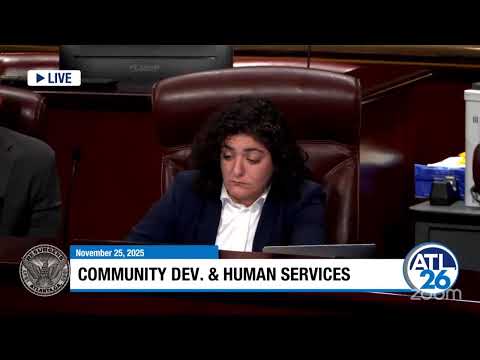
The Community Development & Human Services Committee announced it would not move forward this year with proposed extensions to multiple Tax Allocation Districts, after a wave of public testimony and a statement from the mayor's chief of staff. Chair Jason Winston convened the meeting and, following public comment, noted the council and administration would continue working on the issue next year.
Courtney English, Mayor Andre Dickens's chief of staff, told the committee the administration would "wait until next year" and route the TAD work through a commission process so the public and stakeholders can participate. "In the spirit of collaboration...we're gonna wait," English said, framing the move as an opportunity for broader community review rather than immediate legislative action.
Community members and housing advocates had lined up for the committee's public-comment hours to oppose an immediate, blanket extension of TADs. Sally Flux, founder of the pedestrian advocacy group PEDS, urged the committee to reject extensions because of competing city infrastructure needs, saying many drinking-water pipes are more than a century old and citing an estimate of "$2,000,000,000" to fix them. "These things are not gonna happen if we extend the TADs," Flux said.
Other speakers pressed for a pause to allow an audit and greater public review. Paul Boster and neighborhood leaders warned that the governance and oversight of TAD funds should not be ceded to outside authorities without stronger council control and clearer community representation. Jim Martin, an outspoken critic, argued an extension would sequester future tax revenue and estimated the revenue lost to taxing authorities could exceed $100 million by 2030, calling borrowing against future increment "buy now, pay later."
Incoming District 2 councilmember Kelsey Bond said the delay shows the power of public engagement: "Community participation is what democracy looks like, not shadowy boards of CEOs and corporate interests doling out money." Several advocates asked that any oversight or commission include seats for neighborhood residents and transparent annual reporting.
Councilmembers acknowledged the comments and pointed residents to ongoing Invest Atlanta meetings and the TAD subcommittee. Councilmember Dozier encouraged speakers to participate in Invest Atlanta and TAD subcommittee meetings, noting those venues as additional places where project details and oversight occur. Multiple members stressed the need to include Fulton County and Atlanta Public Schools in discussions about assessment and fiscal impacts.
By the end of the public-comment period and subsequent council remarks, the practical effect was clear: council and the mayor's office will not advance the proposed TAD extension this calendar year and intend to reframe the effort through a commission process and further community engagement in the new year. The committee moved on to its other business without taking final action on TAD extensions.
The committee's next procedural step is to bring revised legislation and commission proposals to public meetings and Invest Atlanta sessions for further review; no vote on extending any existing TADs occurred at this meeting.