Spokane County lays out 2026 legislative priorities, flags $15 million public-defense burden
Loading...
Summary
Spokane County commissioners and state legislators met Dec. 10 to review the county—s 2026 legislative priorities, including public defense cost pressures, behavioral-health facility funding, transportation projects, TIF reform and broadband planning.
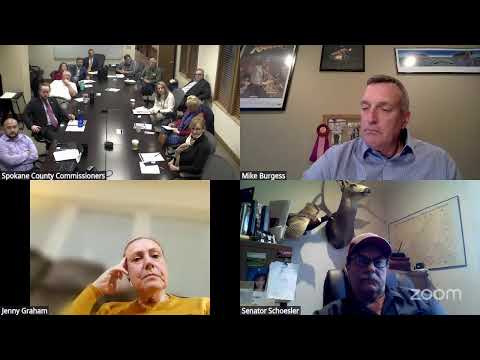
Spokane County officials met in a special session on Dec. 10 to present a list of 2026 legislative priorities they said will protect county services from mounting state-driven costs and advance several local capital projects.
Mike Burgess, the county—s state lobbyist, told legislators that state requirements are shifting costs to counties and cited a Spokane County estimate of about $15,000,000 in public-defense-related pressure the county faces if caseload and indigent-defense standards are fully implemented. "That $15,000,000 number is a Spokane County number," Burgess said while outlining operating-side concerns for county budgets.
The meeting grouped items into broadly countywide priorities (public defense, the Clean Building Act, BECA-related pressures) and more localized capital asks (sobering center expansion, water-district upgrades and transportation corridors). Jeff McMorris, county staff, described the sobering/stabilization center expansion and said a $3,000,000 federal earmark was included last year but did not survive a continuing resolution; he characterized the current pitch as "a second bite of the apple" to close the remaining funding gap for the project.
County leaders also raised the Clean Building Act—s implementation costs and flagged BECA funding reductions as creating downstream county obligations. Representative Dyer Eunice noted that state building audits had produced high retrofit estimates for public institutions and universities.
On infrastructure and economic development, county staff outlined a set of transportation priorities that would improve access to Fairchild Air Force Base and other corridors, and noted prior congressional earmarks and the need for local match. McMorris said some corridor projects had prior congressional earmarks totaling about $8.5 million and that federal grants often require 20–25% local matches, translating to $2–4 million in county matching exposure for some phases.
Housing and tax policy also featured prominently. Commissioner Al French advocated for condo development allowances ("12 units, no higher than 2 stories") to expand homeownership options and discussed ongoing work to relocate mobile-home residents ahead of redevelopment. French and others previewed a push on tax-increment financing reform to favor the county—s 39.89 model and to add public-safety as an allowable use while giving taxing districts an opt-out.
Officials highlighted other project- and program-level items: PFAS and wildfire recovery funding (county officials said Spokane requested $18.5 million last year, received $7.5 million and are seeking the remaining roughly $10 million to complete filtration and mitigation work), a proposed regional sheriff helicopter funding strategy, a planned hydrogen manufacturing facility on the West Plains, and the county—s broadband ambitions tied to potential BEED funding.
The meeting produced no formal votes. Commissioners said they will continue follow-up with legislators as the session begins and will refine specific dollar requests and phasing recommendations for multi-year projects.
The Board of County Commissioners said it will keep legislators apprised as bills are drafted and invited members to raise items not on the agenda before adjourning.