
Narberth council votes to advertise ordinance to raise earned‑income tax to 1%; special meeting set Dec. 1
Get AI-powered insights, summaries, and transcripts
Subscribe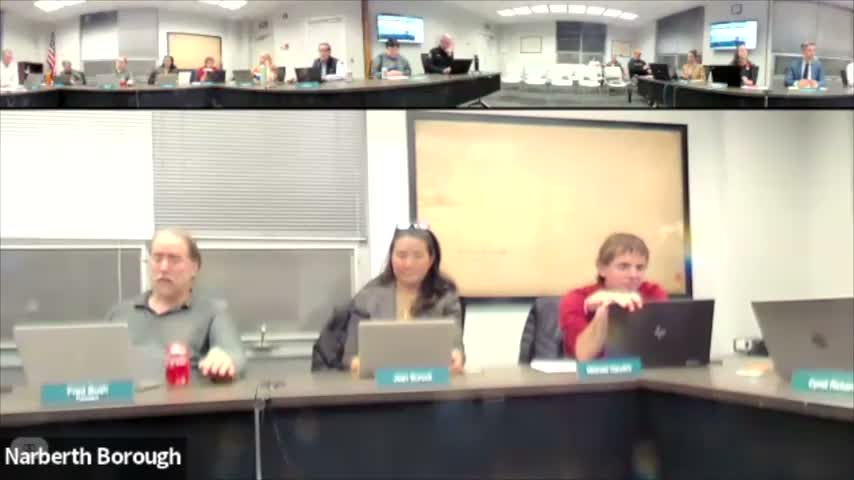
Summary
Narberth Borough Council voted 6–1 to advertise an ordinance that would raise the borough earned‑income tax from 0.75% to 1.0%, the state maximum, saying revenue is needed to fund capital projects. A special meeting to consider final adoption is scheduled for Dec. 1 at 10:30 a.m.
Narberth Borough Council on Thursday voted to authorize advertising an ordinance that would raise the borough’s earned‑income tax (EIT) from 0.75% to 1.0%, the maximum allowed under state law, setting up a special meeting on Dec. 1 to consider final adoption. The advertising vote passed 6–1, with Council member Speer recorded as the lone dissent.
Council members and staff framed the increase as a way to smooth funding for an anticipated $500,000 transfer to the capital fund and to pay for a multi‑year capital improvement plan that includes sewer and stormwater projects, vehicle replacements and building systems. Borough staff said the draft 2026 budget posted on the borough website assumes the higher EIT rate and would allow the borough to accumulate funds more gradually rather than taking on additional debt or pursuing a larger, later tax increase.
Supporters said the EIT spreads the cost across wage earners and captures income earned in other municipalities that currently flows elsewhere. “We’re going to be able to smooth out that process over the next couple of years to be in much better financial position,” a council member said during the debate.
Opponents argued that a property‑tax (millage) increase would be fairer to residents on fixed incomes and less likely to harm the downtown business district. One council member said higher EIT “is essentially a wage tax” that does not tax investment income and could disadvantage local employers. Council members discussed the mechanics and the county tax manager’s role in collecting and apportioning EIT revenue.
The vote to advertise the ordinance does not change tax rates immediately; if council adopts the ordinance at the Dec. 1 special meeting, the change would take effect Jan. 1, per staff. The borough will take public comment on the EIT only at that single‑issue meeting.
What’s next: the borough will hold a special meeting Dec. 1 at 10:30 a.m. to consider final adoption of the EIT ordinance; if adopted, the borough will report the change to the state Department of Community and Economic Development and the rate would apply beginning Jan. 1.