
District SRO update highlights training, logs and questions over disaggregated data
Get AI-powered insights, summaries, and transcripts
Subscribe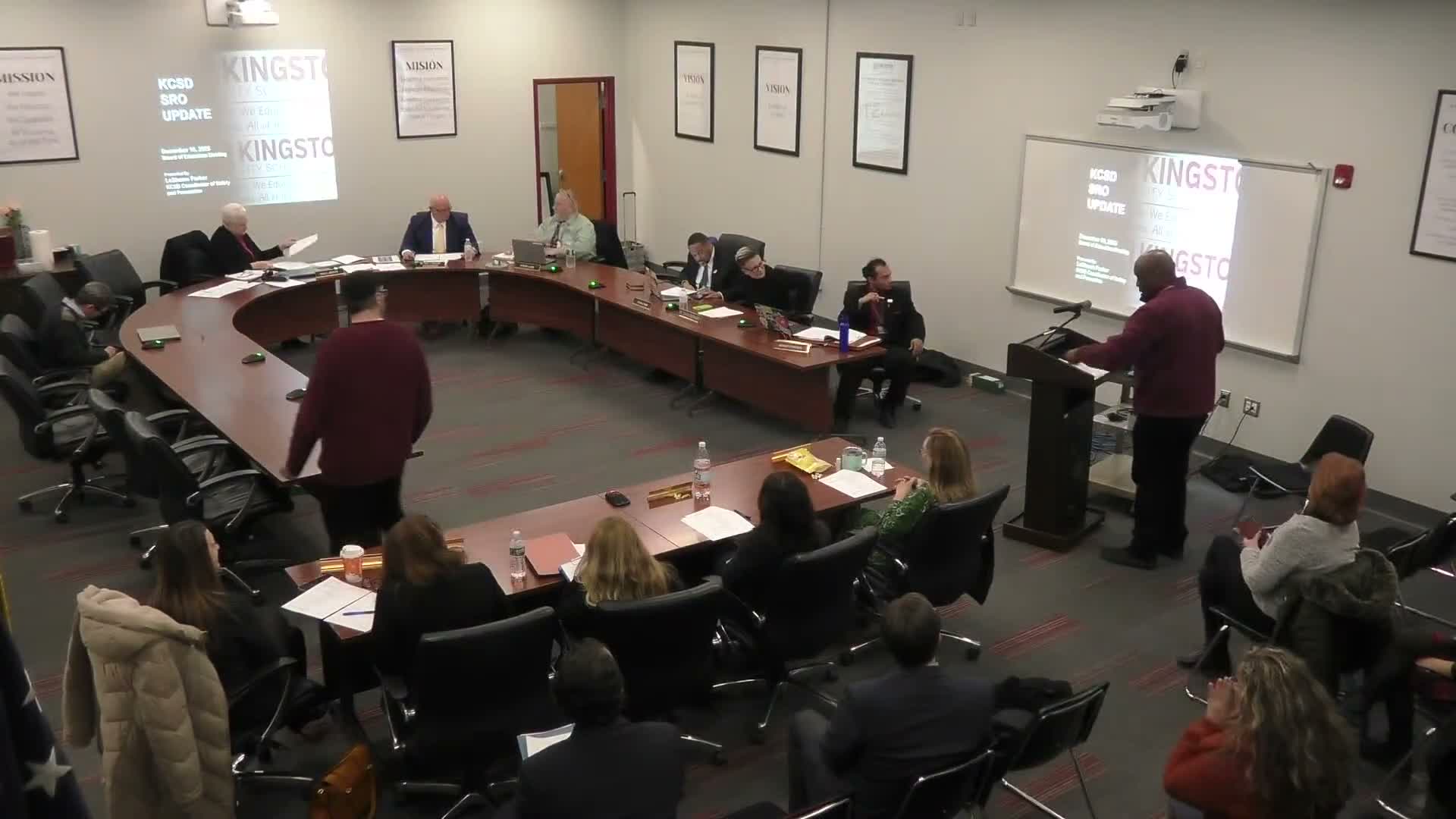
Summary
Director of Safety and Prevention Mr. Parker presented an SRO program overview to the Kingston City School District board, emphasizing training, daily duties and relationship-focused interactions; trustees questioned whether incident and interaction data are disaggregated by race, disability and gender identity.
Mr. Parker, the district’s Director of Safety and Prevention, presented an overview of the School Resource Officer (SRO) program, describing SRO duties, training requirements and program reporting. He said SROs assigned in the district are sworn law-enforcement officers with DCJS-approved training and participate in activities beyond security, such as relationship-building, parent conferences, sporting-event support and threat assessment work.
Parker described ongoing professional development (including a November supplemental training on vaping and drug trends and a session on immigration law and policy), a 2020 SRO committee that reviews contracts and program practices, and a district logging system that records SRO interactions. He reported that SROs logged over 1,000 interactions last year and characterized about 80% of logged interactions as relationship-building and general dialogue, with the remainder involving assistance or formal incidents.
Trustees pressed on equity and data disaggregation. One asked whether SRO interaction rates are proportionate to the student population or disproportionate by race or disability. Parker said interaction rates are “virtually identical” to school demographics and offered to provide comparative breakdowns for the board. When asked about gender non‑binary data collection, Parker replied the district has not systematically collected that information because those questions are voluntary; he said the district could attempt to provide additional disaggregations if feasible.
Board members also referenced historical identification by the state of disproportionate suspensions for students with disabilities, noting that in recent years the district has not been identified as disproportionate. Parker and the superintendent offered to follow up with comparative reports and additional detail.
The board’s discussion concluded with a plan for Parker to provide requested breakdowns and for the district to continue monitoring SRO logs and training.