Get Full Government Meeting Transcripts, Videos, & Alerts Forever!
Get email alerts on the Housing topic
No spam. Unsubscribe anytime.
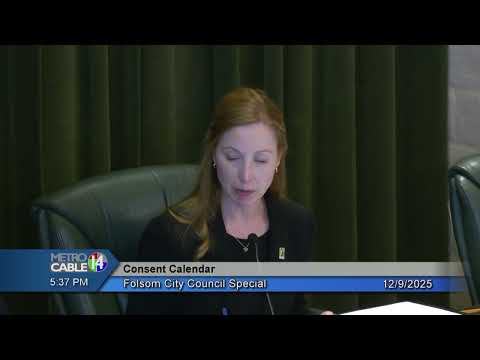
Folsom council approves first reading of updated inclusionary housing fee; staff to return with exemptions to incentivize middle homes
Summary
The City Council introduced Ordinance No. 1359, recasting Folsoms inclusionary in-lieu fee as a per-square-foot charge to reduce administrative burden; staff recommended $3.00/sq ft for most ownership products, $2.50/sq ft for homes under 1,500 sq ft, and retained an exemption for multifamily rentals. Council approved first reading and asked staff to return with targeted exemption options.
The Folsom City Council on Dec. 9 voted to introduce Ordinance No. 1359, updating the citys inclusionary housing in-lieu fee methodology from subdivision-specific calculations to a simplified per-square-foot approach staff says will reduce administrative work and give developers upfront certainty.
Planning Manager Desmond Perrington told the council the new approach is based on a nexus-style analysis assembled by Economic and Planning Systems and would index fees to construction costs so they move with the market. "This approach simplifies significantly the administrative work that staff has to do," Perrington said, explaining the proposal replaces roughly 75 individually tracked subdivision fee levels with a uniform per-square-foot fee.
Amy Lappin, principal with Economic and Planning Systems, walked the council through the three-step methodology used to set a legally supportable fee: quantify the affordability gap for representative housing prototypes; estimate the number of worker households generated by new market-rate units; and combine those factors to calculate a maximum justifiable per-square-foot fee. Lappin said the study produced a high theoretical maximum but staff recommended a conservative fee of roughly 10% of that maximum to preserve development feasibility.
Under staffs recommendation, the council heard that the recommended in-lieu fee would be $3.00 per square foot for low- and medium-density single-family ownership products and $2.50 per square foot for homes under 1,500 square feet. The city would continue to exempt multifamily rental apartments from the fee because the analysis shows a roughly $40,000 per-unit feasibility gap for rental apartments that would make fees infeasible for that product type.
The proposal prompted questions from multiple council members about whether the studys unit prototypes reflect what is actually being built in Folsom and whether the per-square-foot approach unintentionally disincentivizes smaller for-sale products the council wants to encourage. "I'm not in favor of these fees for-sale condominiums and townhomes," said Vice Mayor Raithful, who urged exploring ways to incentivize more starter homes and townhome ownership. Councilmember Kozlowski asked whether the city is legally required to maintain an in-lieu fee program; the city attorney said the current ordinance originates from a settlement and remains in force unless changed.
After debate, the council voted to introduce and conduct first reading of Ordinance No. 1359 and directed staff to return with specific exemption or floor formulas to better incentivize moderate-income for-sale products. Roll call on the motion to introduce the ordinance was Leary yes; Raffel no; Rohrbaugh yes; Kozlowski yes; Aquino yes. The ordinance will return for a second reading on Jan. 13, when staff also plans to bring a resolution setting the specific fee levels. If adopted on the second reading and later formal actions, staff said the ordinance could take effect on Feb. 12, 2026.
Why it matters: City officials said the new per-square-foot structure reduces calculation errors, saves staff time and provides developers clearer forecasts of fees prior to submitting building permits. Critics warned the approach could unintentionally raise costs on larger homes and asked council to consider sale-price or prototype-based exemptions to safeguard efforts to expand attainable for-sale housing.
Next steps: Second reading on Jan. 13 and a subsequent resolution to set the fee schedule; staff was asked to return with exemption options tied to sale price or other criteria to encourage "missing-middle" for-sale products.