
Acton-Boxborough committee reviews four AB Forward reorganization options as community urges alternatives
Summary
Consultants and the steering committee presented four reorganization options to the Acton-Boxborough Regional School Committee; parents and teachers urged preserving Miriam and McCarthy Town while committee members asked for clearer reassignment, operational and financial details before narrowing choices.
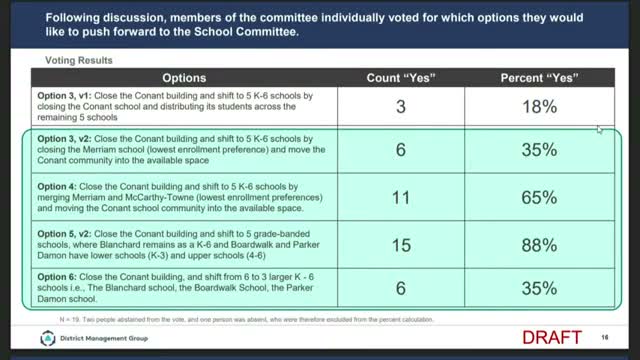
Consultants from DMG presented four reorganization options the district steering committee advanced after more than 2,000 stakeholder touch points, and the school committee opened a broad deliberation amid strong public concern about proposed school closures and redistributions.
The steering-committee presentation, delivered by DMG consultants Joe and Yash, framed the options against the district’s new strategic-plan language and a theory of action emphasizing student academic outcomes, staff supports, welcoming school communities and sustainable systems. "We were then able to really engage in a robust stakeholder engagement process with over 2,000 individual touch points," a consultant said, summarizing the outreach that informed the options.
Why it matters: the proposals would reconfigure elementary-school boundaries and administrative structures and could affect where students and staff are placed. Several options would close or merge existing school communities; other options reorganize schools into larger or grade-banded models that the administration says give more staffing flexibility.
What the options are: among the four advanced to the committee were (a) a variant that would close Miriam Elementary, (b) a merger option affecting Miriam and McCarthy Town, (c) a partial grade-banded model splitting lower and upper K–6 within campuses (option 5), and (d) a plan creating three larger schools with a different administrative structure (option 6). Consultants said options 5 and 6 produce similar operational efficiencies but differ most on administrative staffing and community size; projected cost differences between 5 and 6 were modest ("maybe $10,000–$15,000" in the presentation).
Community reaction: in a 15‑minute public-comment block and additional speakers, parents, teachers and former steering-committee members urged the committee to protect certain schools and programming. One parent who said she had been involved in planning for Miriam told the committee: "I will be clear, that cannot happen in option 3 version 2 and is unlikely to happen in option 4," referring to the district’s project‑based curriculum and instructional model. Multiple speakers argued that Conant and Miriam families would shoulder disproportionate disruption under the most-discussed scenario and asked the committee to prioritize continuity for vulnerable cohorts.
Committee response and next steps: members pressed for more operational detail (draft reassignment procedures for each option, floor plans and capacity analyses, special‑education and multilingual-program continuity, and more explicit calculations of the scale and type of "disruption"). One committee member moved to remove options 3 and 4 from consideration but withdrew the motion after extended debate about procedure and fairness. Chair Tori asked staff and consultants to provide comparative, operationally focused materials in advance of the committee’s next meetings; committee members set homework to read distributed materials and return with targeted questions.
Quotations to note: Superintendent Peter said the committee must balance educational goals and fiscal realities when choosing a model. Miriam principal Christina Gavin described her school’s focus on job‑embedded professional learning, SEL and reduced behavioral incidents as evidence of success in its model: "We are seeing that student growth is evident, and we are seeing our behavioral incidents come down overall for the majority of our students." A consultant summarized the steering committee’s deliberative approach: "The steering committee voted to move the four options forward to you all, again, so that you can then have the final deliberation."
What’s next: the committee requested more precise reassignment procedures and a comparative operational and financial summary for options 4, 5 and 6. The committee signaled it will continue deliberations in subsequent meetings (the packet referenced hearings and a January 8 public hearing and a later decision window), and staff said draft implementation materials would be provided to the committee prior to further votes.

Create a free account
Unlock AI insights & topic search